
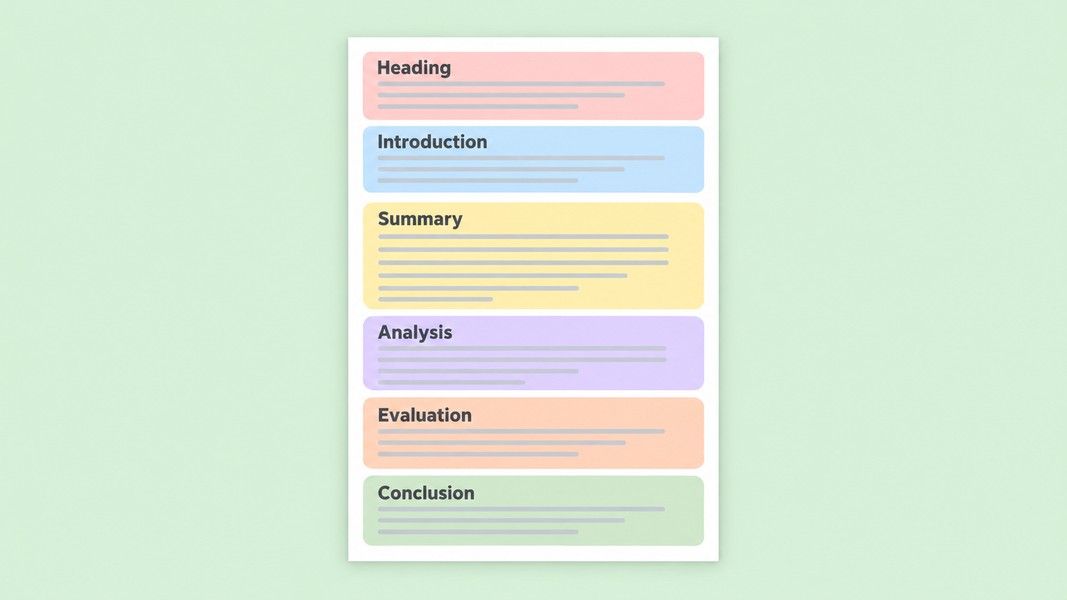
A book report template is the fixed order every report follows: the book's details, an introduction, a summary of what happens or what the author argues, a short analysis of characters, themes or main ideas, your evaluation, and a conclusion. According to the Purdue OWL, book reports are mostly a K-12 assignment, usually run from 250 to 500 words, and discuss a book from an objective stance, with the summary taking up most of the page.
What changes is the depth. A second grader fills in a one-page frame, a middle schooler adds a thesis, and a high school report expects analysis backed by quotes. This guide gives you the core structure, a version for each grade band, separate fiction and nonfiction formats, the MLA layout most teachers ask for, and the order that makes writing one faster.
What a Book Report Template Includes
Almost every template you will find, from elementary worksheets to college library guides, uses the same building blocks. The difference between a weak report and a strong one is usually balance: too much opinion and too little summary, or a summary that retells every chapter and never says what the book means.
| Section | What goes in it | Share of the report |
|---|---|---|
| Heading | Your name, teacher, class, date, report title | One block |
| Introduction | Title, author, genre, publication details, one or two sentences on what the report covers | One paragraph |
| Summary | Plot, setting and characters for fiction; topic and main points for nonfiction | The largest part |
| Analysis | Theme, author's purpose, style, or the strength of the argument | One or two paragraphs |
| Evaluation | What worked, what did not, who should read it | One paragraph |
| Conclusion | The impression the book left and the point you want your reader to keep | A few sentences |
Most of the report should be summary, and the summary should still be selective. The Purdue OWL advises making sure most of the paper summarizes the work before you analyze characters or themes. Concordia University Library adds the bibliographic part that younger students tend to skip: author, full title with subtitle, publisher, place and date of publication, edition and number of pages.
Book Report vs Book Review
The two get mixed up constantly, and the difference decides how much opinion you can include. The Concordia guide to reports and reviews defines a book report as an objective summary of the author's main ideas and arguments, and a book review as a critical account that assesses the book's value and recommends it or not.
A review is built around your judgment. The UNC Writing Center describes a review as a commentary rather than merely a summary, with a thesis, supporting paragraphs and a conclusion, and notes that published reviews rarely exceed 1000 words. If your assignment sheet asks whether the book succeeds, you are writing something closer to a review, even if it is called a report.
Book Report Templates by Grade Level
The same six blocks scale up as students get older. The grade bands below follow how school writing guides describe the assignment; your teacher's rubric always comes first.
Elementary School (Grades 2 to 5)
Young writers need a frame, and the story order is the frame. Ask them to cover the title and author, the main characters, where and when the story takes place, what happens at the beginning, middle and end, the problem and how it is solved, and their favourite part with a reason.
Once students write in paragraphs, Enchanted Learning suggests a structure that already looks like a real essay: an introductory paragraph with the title, author and type of book, then at least four to five paragraphs that each cover one topic, such as the main character or the setting, and a closing paragraph on what the reader learned and whether they liked the book. One paragraph per topic is the habit worth building early.
Middle School (Grades 6 to 8)
Middle school reports add two things: a thesis and an explanation of how the author builds meaning. The introduction now ends with a claim, for example that the author uses a particular setting to show how a character changes.
The summary shrinks to the setting, main character, central conflict and turning point, leaving minor events out. An analysis paragraph then takes one technique or idea, supports it with a short quotation, and explains what that quotation shows. The evaluation names one strength and one weakness.
High School (Grades 9 to 12)
High school teachers grade format as well as content. A Los Angeles Unified guideline for book reports is typical: typed or written in blue or black ink, a body of at least 200 words, double-spaced in 12-point Times or Times New Roman, and a header with your name, date, class period and subject. It also penalizes uncorrected typing and grammatical errors.
The content shifts toward analysis and evaluation. Fact Monster's homework guide for middle and high school lists the questions to answer: whether the author achieved their purpose, whether the writing is effective, what the book's strengths and weaknesses are, and, for nonfiction, whether the author is qualified to write about the subject.
College and University
At college level, a book report usually becomes a book review. The Purdue OWL notes that reviews are most often a college assignment, and they also appear in magazines, newspapers and academic journals. Expect a thesis about the book's value, a summary short enough to leave room for argument, and full bibliographic information in the citation style your course uses, which the Concordia guide places under the title of the report.
Fiction Book Report Format
A fiction report is organised around story elements. The NDLA guide to writing book reports lists what the main body of a fiction report should cover, and the table below follows it.
| Element | What to write about it |
|---|---|
| Setting | Where and when the story takes place, including the social conditions of the time |
| Main characters | Who they are, their personalities, and how they change |
| Plot summary | The most important events in order, not every scene |
| Climax | The turning point, the most intense moment of the story |
| Point of view | Whose eyes the story is told through |
| Style and tone | The author's word choice, mood and use of devices such as metaphor or foreshadowing |
| Themes | The main ideas behind the story |
| Personal impressions | What you thought, including your view of the ending |
Take The Secret Garden by Frances Hodgson Burnett as an example. A strong fiction report would introduce Mary Lennox and her move from India to her uncle's house in Yorkshire, summarise how she finds and restores the locked garden with Dickon and her cousin Colin, and then argue that the garden's recovery mirrors the children's own. That last step turns a retelling into a report with a point.
Nonfiction Book Report Format
A nonfiction report follows the author's argument instead of a plot. You explain the topic, the main thesis, the evidence the author uses, and the conclusions the book reaches, then say whether you were convinced.
| Section | What to write about it |
|---|---|
| Author's topic | What the book is about and why the author wrote it |
| Main points | The central thesis and a short summary of the key ideas |
| Arguments | The evidence and reasoning the author uses, and whether you agree |
| Author's qualifications | What makes the author credible on this subject |
| Conclusions | The author's final position, and your view of it |
| What you learned | What you did not know before, and whether you would recommend the book |
The common mistake here is chapter-by-chapter summary. The same Fact Monster guide warns against trying to summarise each chapter or every angle; choose the ideas that are most significant and build the report around them.
Biographies sit between the two formats. The Purdue OWL suggests tracking major characters for biographies the same way you would for fiction, while still treating the book's main ideas as the backbone.
Book Report Format: MLA Heading and Layout
When a teacher says "MLA format", they mean the page layout, not a special book report structure. The MLA general format page at Purdue sets out the rules.
| Element | MLA rule |
|---|---|
| Page and margins | 8.5 x 11-inch paper, 1-inch margins on all sides |
| Font and spacing | A legible font such as Times New Roman, 12 point, double-spaced throughout |
| First-page heading | Your name, instructor's name, course and date, top left, double-spaced |
| Running header | Your last name and the page number, top right, half an inch from the top |
| Title | Centered, Title Case, not underlined, italicized or in quotation marks |
| Book titles in your text | In italics, for example The Secret Garden |
| Paragraphs | First line indented half an inch |
Skip the separate title page unless your teacher asks for one; MLA does not use one by default. If your report title includes the book's title, that part goes in italics, as in "Healing and Growth in The Secret Garden".
How to Write a Book Report in 6 Steps
A template tells you where things go. The order you write in is what saves time, because the summary and analysis are easier to write than the introduction.
Step 1: Record the Book's Details Before You Start
Write down the author, full title, publisher, place and year of publication, and number of pages before you read a single chapter. Both the Purdue OWL and the Valley College library guide list these as the first information a report needs, and hunting for them the night before the deadline wastes time.
Step 2: Take Notes While You Read
Keep notes as you go, with page numbers for scenes and quotes you might use. Track the characters in fiction and the main ideas in nonfiction. A short system for annotating a book makes the later steps much faster, because the evidence is already marked.
If you read on paper, Primo Notes can photograph a page and turn the printed text or your handwritten margin notes into a written note. You can also record a two-minute spoken recap after each chapter and get back a transcript and a structured note, which gives you a running summary without typing.
Step 3: Build an Outline From Your Notes
Sort your notes into the template's sections: summary points, two or three analysis points, and one strength and one weakness for the evaluation. Delete anything that does not fit. If a scene is memorable but supports none of your points, it does not belong in the report.
Step 4: Write the Summary First
Draft the summary while the book is fresh. Keep it to the events or ideas a reader needs to follow your analysis, in the order they happen. Practice with summarizing a chapter helps here, because the skill is choosing what to leave out.
Step 5: Add Analysis and Evaluation
Pick one theme, technique or argument and explain it with evidence. Then judge the book: did the author achieve their purpose, what are its strengths and weaknesses, and who would enjoy it. Support every opinion with an example, which is exactly what the high school guidelines above ask for.
Step 6: Write the Introduction and Conclusion, Then Proofread
Now that you know what the report says, write an introduction that names the book and states your main point, and a conclusion that pulls your thoughts together. Check your heading, spacing and italics against the format your teacher set, and read the whole report aloud once to catch errors.
Before you hand it in, test yourself. In Primo Notes, the quiz tool on your reading note asks you questions about the material, and Ask AI lets you check a detail against your own notes. Both help you confirm you understood the book; the report itself still has to be in your words.
Book Report Outline: Putting the Pieces Together
The sections, the grade-level depth and the format work as one system. Here is how a standard five-paragraph report for middle or high school lays out.
| Paragraph | Purpose | Draws from |
|---|---|---|
| 1. Introduction | Title, author, genre, publication year, your main point | Step 1 details, Step 5 analysis |
| 2. Summary | Setting, characters and main events, or topic and main points | Step 2 notes |
| 3. Analysis | One theme or technique, with a quotation and page number | Step 2 quotes |
| 4. Evaluation | One strength, one weakness, and who should read it | Step 5 judgment |
| 5. Conclusion | The impression the book left and what you want the reader to remember | Your outline |
For a younger reader, collapse paragraphs 3 and 4 into one paragraph about a favourite part. For a college review, expand paragraph 4 into the core of the paper and shorten paragraph 2.
Common Book Report Mistakes
Most lost marks come from a short list of avoidable problems.
- Retelling the whole book: a summary that covers every event leaves no room for analysis and reads as filler.
- Opinion without evidence: "I liked it" earns nothing; "the narrator's voice made the ending land because..." earns the mark.
- Missing book details: leaving out the author, genre or publication information in the introduction is the easiest error to avoid.
- Writing a review when a report was assigned: a report stays mostly objective; check which one your teacher wants.
- Ignoring the format: wrong spacing, an underlined title or a missing header cost points on rubrics that grade presentation.
Conclusion
A book report template is the same six parts at every level: heading, introduction, summary, analysis, evaluation and conclusion. What changes from grade to grade is depth, from a one-page story frame in elementary school to a thesis-driven analysis in high school and a full review in college.
Fiction reports follow setting, characters, plot and theme, while nonfiction reports follow the author's topic, argument and conclusions. Record the book's details first, take notes with page numbers as you read, write the summary before the introduction, and check the format last. That order turns a blank page into a finished report with far less rewriting.