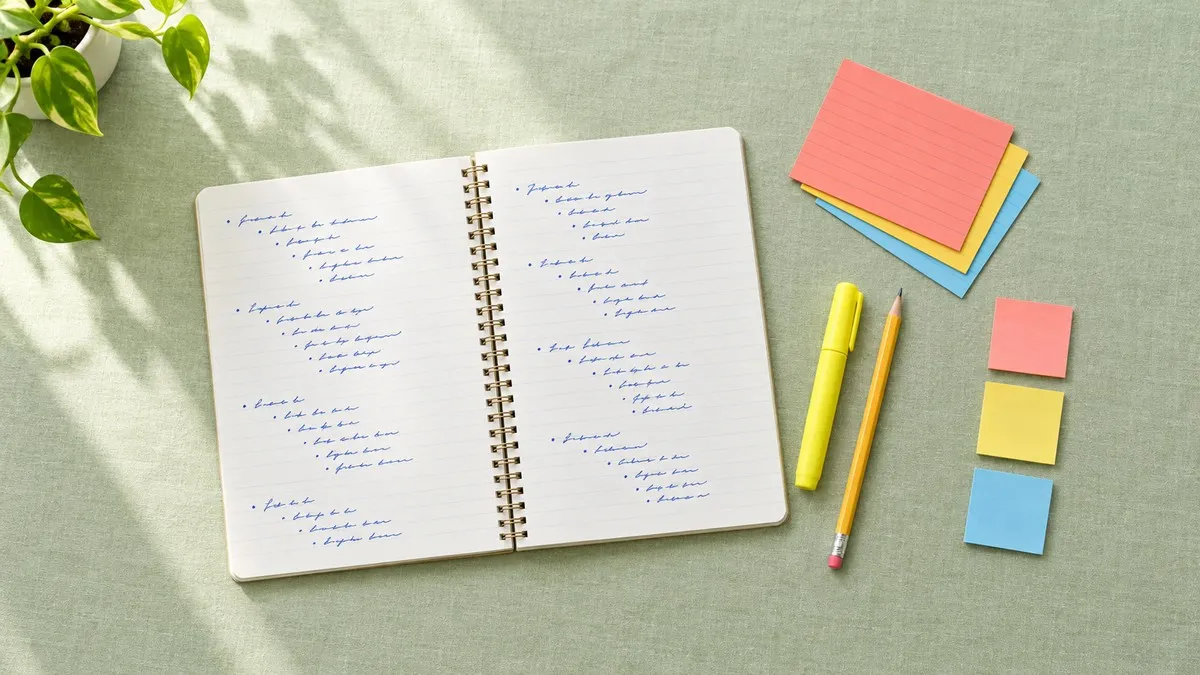
An essay outline is a ranked list of your thesis, main points and supporting evidence, written in the order the finished essay will present them. It usually runs from Roman numerals for the main sections down to letters and numbers for the details, so you can see the whole essay before you write a sentence of it.
The hard part is not the format. It is knowing what each type of essay needs in each slot: where an argumentative essay puts the counterargument, how a compare and contrast essay splits two subjects, what a research essay attaches to every point. This guide covers how to write an essay outline step by step, then gives five filled-in templates you can adapt, and ends with what the research says about whether outlining is worth the time.
What an Essay Outline Includes
Every essay outline has the same three layers: an introduction that ends in a thesis, body sections that each carry one supporting point, and a conclusion. The differences between essay types sit inside the body.
The Purdue OWL describes three common outline formats, and the choice between them is mostly about how much you want written down before you draft.
| Format | How it looks | Best for |
|---|---|---|
| Alphanumeric | I, A, 1, a, with short phrases | Most essays, quick planning |
| Full sentence | Same levels, every line a complete sentence | Long essays, outlines you submit |
| Decimal | 1.0, 1.1, 1.1.1 | Research papers, technical writing |
Purdue calls the alphanumeric outline the most common type. It also notes that the full sentence version is essentially the same structure, just with complete sentences at every level, and that the decimal version makes it clearer how each level relates to the whole.
If your instructor asks you to submit the outline, check which format they want before you start. Converting a phrase outline into full sentences later is easy; reorganizing a decimal outline into Roman numerals is tedious.
How to Write an Essay Outline in 6 Steps
Purdue's guide on creating an outline breaks the process into three decisions and four actions. Here they are as six steps, with the order that saves the most rework.
1. Pin Down the Purpose and Audience
Read the prompt and write one line on what the essay must do (argue, explain, compare, report research) and one line on who will read it. An explanatory essay for classmates and an argumentative essay for a skeptical reader need different body sections.
If your instructor explained the assignment out loud, the details that matter are often in that explanation rather than on the handout. Recording the class in Primo Notes gives you a transcript and a structured note, so you can check the exact wording of the requirements instead of relying on memory.
2. Write a Working Thesis
Your thesis is the line every other line in the outline has to support. Write it as one sentence that makes a claim, not a topic. "Social media and teenagers" is a topic; "Schools should teach social media literacy as a required course" is a thesis you can outline.
Call it a working thesis because it will probably shift. That is normal, and the outline is the cheapest place for it to happen.
3. Brainstorm Everything
List every idea, example, quote and source you might use, without sorting. Aim for more material than you need, because the next step cuts it down.
If your research notes are already in one place, this step goes faster. In Primo Notes, the mind map tool turns a finished note into a branching map of its main ideas, which gives you a first view of what belongs together before you start grouping by hand.
4. Group Related Ideas
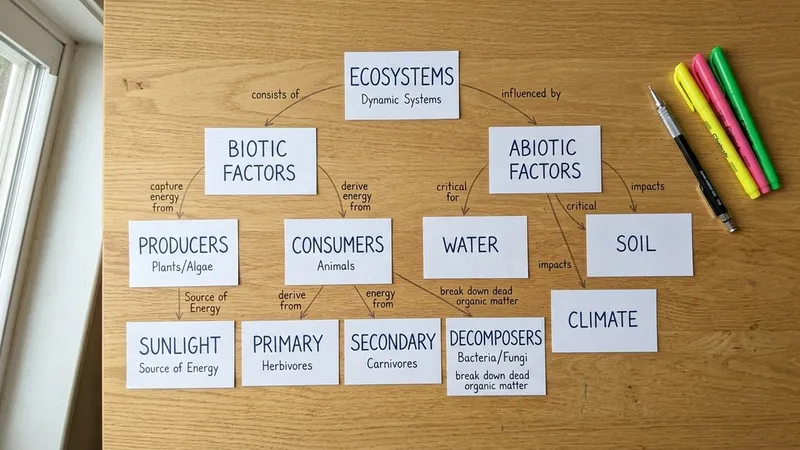
Sort the brainstorm into clusters. Each cluster that supports the thesis becomes a candidate body section; anything that fits nowhere gets cut or saved for the conclusion. A five-paragraph essay needs three; longer essays need more.
5. Order the Groups
Arrange the clusters in the order that best moves a reader toward your thesis. Common orders are strongest point last, chronological, or general to specific. Purdue recommends ordering material from general to specific or from abstract to concrete within each section.
6. Label the Headings and Check Four Rules
Turn each cluster into a heading and its contents into subheadings. Then check the four rules Purdue lists in its outline components guide:
- Parallelism: headings at the same level share a grammatical form, so if one starts with a verb, they all do.
- Coordination: headings at the same level carry the same weight.
- Subordination: headings are general, subheadings are specific.
- Division: every heading splits into two or more parts. A heading with a single subpoint usually means the subpoint is the heading.
The same hierarchy works for class notes, and the outline method for notes uses it to sort a lecture as it happens.
Template 1: Five-Paragraph Essay Outline
The five-paragraph essay is the standard shape for timed writing and early high school assignments: one introduction, three body paragraphs and a conclusion. Each body paragraph proves one reason behind the thesis.
| Section | What goes in it | Example |
|---|---|---|
| I. Introduction | Hook, context, thesis with three reasons | Community gardens strengthen neighborhoods by improving diets, connecting neighbors and reclaiming empty lots |
| II. Body paragraph 1 | Reason one, evidence, explanation | Diet: fresh produce close to home |
| III. Body paragraph 2 | Reason two, evidence, explanation | Connection: shared work builds trust between neighbors |
| IV. Body paragraph 3 | Reason three, evidence, explanation | Land use: vacant lots become maintained space |
| V. Conclusion | Restated thesis, why it matters | Gardens are a low-cost investment in a block's health |
Keep the three reasons in the same order in the thesis and in the body. A reader who sees "diets, neighbors, empty lots" in the introduction expects to meet them in that order.
The Harvard College Writing Center points out that students used to this one-claim, three-point shape often find longer essays daunting. Treat it as a starting structure, not a rule: once an assignment asks you to weigh evidence or answer objections, you need one of the templates below.
Template 2: Argumentative Essay Outline
An argumentative essay outline adds the piece the five-paragraph version leaves out: the reader who disagrees. Harvard's guide to addressing counterarguments says a counterargument should not be something added after the essay is finished, which is exactly why it belongs in the outline.
| Section | What goes in it | Example |
|---|---|---|
| I. Introduction | Issue, why it matters now, thesis | High schools should start no earlier than 8:30 a.m. |
| II. Claim 1 | First reason, evidence, analysis | Evidence on how teen sleep timing changes |
| III. Claim 2 | Second reason, evidence, analysis | Evidence from districts that changed start times |
| IV. Counterargument | The strongest objection, stated fairly | Later starts disrupt bus schedules and after-school jobs |
| V. Rebuttal | Why your thesis still holds, or how it adjusts | Staggered bus routes; the objection limits the change rather than defeating it |
| VI. Conclusion | Restated claim, what should happen next | A policy recommendation for the district |
Harvard notes that a counterargument often complicates your argument without refuting it, and that it can sit right after your thesis or anywhere a thoughtful reader would push back. The template places it after your claims, which is the most common layout; move it earlier if the objection is so obvious that readers will hold it the whole way through.
Template 3: Compare and Contrast Essay Outline
A compare and contrast essay outline has two possible shapes. A handout from the San José State University Writing Center explains when to use each: the block approach for short essays such as in-class papers, and the point-by-point approach for longer essays such as a comparison of two novels.
The handout's own practice example compares fast food with home-cooked meals on cost, convenience and health. Here it is in both shapes.
| Section | Block approach | Point-by-point approach |
|---|---|---|
| I. Introduction | Thesis: cooking at home is the healthier choice | Same thesis |
| II. | Fast food: cost, convenience, health | Cost: fast food vs. home-cooked |
| III. | Home-cooked meals: cost, convenience, health | Convenience: fast food vs. home-cooked |
| IV. | (none) | Health: fast food vs. home-cooked |
| V. Conclusion | What the comparison shows | What the comparison shows |
The block approach is easier to write and harder to read, because the reader has to remember the first subject's details while reading about the second. Point-by-point puts the two subjects side by side in every section, which is why it holds up better over longer essays. Whichever you choose, use the same points of comparison for both subjects, in the same order.
Template 4: Expository Essay Outline
An expository essay explains a process, idea or event without arguing for a side. Purdue's sample outline uses this exact assignment: explain the typical steps a high school student follows to apply to college, written for students and their parents.
| Section | What goes in it | Example |
|---|---|---|
| I. Introduction | Topic, audience, thesis that previews the stages | Applying to college follows a predictable sequence of stages |
| II. Stage 1 | First step, what it involves, common mistakes | Choose colleges: visit campuses, compare websites |
| III. Stage 2 | Second step, details | Prepare the application: forms, essays, recommendations |
| IV. Stage 3 | Third step, details | Submit and follow up: deadlines, confirmations |
| V. Conclusion | Summary of the process, final advice | Starting early makes every stage easier |
Expository outlines usually follow chronological order, so the ordering step is decided for you. The place they go wrong is coordination: if one heading is a whole stage and the next is a single task, the essay will feel lopsided. Keep every main heading at the same level of the process.
Template 5: Research Essay Outline
A research essay outline attaches a source to every claim before you start drafting. The Excelsior OWL's traditional outline model goes four levels deep for each supporting point: the point itself, a supporting detail, an example, and the source behind it, with a marked spot for a counterargument you need to address.
| Level | What goes in it | Example |
|---|---|---|
| I. Introduction | Background, research question, thesis | Microplastics reach drinking water through three main pathways |
| II. Supporting point | One pathway or finding | Wastewater discharge |
| A. Supporting detail | What the research shows | What studies of treatment plants found |
| 1. Example | A specific case or data point | One study's findings on treated effluent |
| a. Source | Author, year, page | The citation you will use |
| III, IV. Further points | Same four levels for each | Runoff; atmospheric deposition |
| V. Conclusion | Answer to the research question, limits, open questions | What current research cannot yet measure |
Filling the source line during outlining is what keeps a research essay from stalling at the drafting stage. If a point has no source yet, you know where to research next instead of discovering the gap mid-paragraph.
Where Your Reading Notes Fit
This is also where your reading notes do the most work. Upload source PDFs or paste a web page link into Primo Notes, and each one becomes a written note you can question with Ask AI, so the example and source lines come from your own material. When you move evidence from a source into the outline, write it in your own words now, and the guide on how to paraphrase covers how to cite it correctly.
Does Outlining Actually Improve Essays?
The evidence says yes, with a cost that is smaller than it looks. In an experiment by cognitive psychologist Ronald Kellogg, college students wrote a short informative essay in 30 minutes after one of three conditions: no planning, 10 minutes of clustering ideas, or 10 minutes writing a standard hierarchical outline.
The outline group scored higher on content quality, rated on a 7-point scale (5.5, against 5.0 for no planning and 4.9 for clustering), and on style (5.4, against 4.7 for both other groups). They also wrote longer essays in the same 30 minutes, about 413 words against roughly 331 for the other two groups.
Kellogg was careful about the efficiency claim. Once the 10 minutes of outlining are counted, the outline and no-planning groups were about equally efficient overall. In other words, outlining did not save time, but it did not cost any either, and the essays were better.
What an Electronic Outline Changes
A 2014 study in Computers & Education looked at a digital version. Ninety-three Dutch 10th graders wrote argumentative texts with or without an electronic outlining tool. The outline improved how clearly students presented their argumentative structure, but it had no effect on how well they elaborated their arguments, and it increased total writing time. Repeated use of the same strategy made students more fluent.
The takeaway from both: an outline improves organization reliably. It does not supply better ideas or evidence on its own, which is why the research and grouping steps matter more than the numbering format.
Reverse Outlining When the Draft Comes First
Some writers cannot outline before they draft, because their ideas only take shape on the page. The Harvard College Writing Center's essay writing guide acknowledges this directly: ideas develop as we write, so it can help to write the draft first and outline it afterwards.
A reverse outline works like this. Read your draft and note, in a few words, what each paragraph does. Then list those notes in order on a fresh page and read the list as if it were an outline someone else wrote.
Harvard suggests asking a few questions of that list. Do points near the end belong earlier? Are points missing? Does any paragraph do two jobs, or repeat another? Check the list against your thesis: every line should support it, and anything that does not is a candidate for cutting.
Reverse outlining also works as a final check on an essay you outlined first. Drafts drift, and comparing the reverse outline with the original shows where.
How the Five Templates Fit Together
The five templates are variations on one structure, so you can combine them when an assignment calls for it. A research paper that takes a position is a research outline with an argumentative body: each claim gets its source lines, and a counterargument section sits before the conclusion. A compare and contrast essay on two historical events can borrow the expository template's chronological order inside each comparison point.
A practical sequence for any essay:
- Identify the essay type from the prompt and start from the matching template.
- Run the six steps, filling the template's slots with your thesis, groups and evidence.
- Check parallelism, coordination, subordination and division, then draft section by section, and reverse outline the draft before you submit.
The outline does not need to be pretty. Purdue's own advice is that any kind of outline, even jotting down a few main ideas, helps the writing process.
Conclusion
An essay outline is your thesis, main points and evidence in the order the essay will present them, usually in the I, A, 1, a format. Writing one means deciding the purpose and audience, drafting a working thesis, then brainstorming, grouping, ordering and labeling your ideas.
The five templates cover the essays most students write: five-paragraph for timed and introductory work, argumentative with a counterargument and rebuttal, compare and contrast in block or point-by-point form, expository in process order, and research with a source attached to every point.
Research on outlining supports the habit. In Kellogg's experiment, ten minutes of outlining produced better and longer essays without slowing writers down overall, and later work found outlines improve how clearly an argument's structure comes across. When the ideas only come during drafting, a reverse outline gives you the same check after the fact.