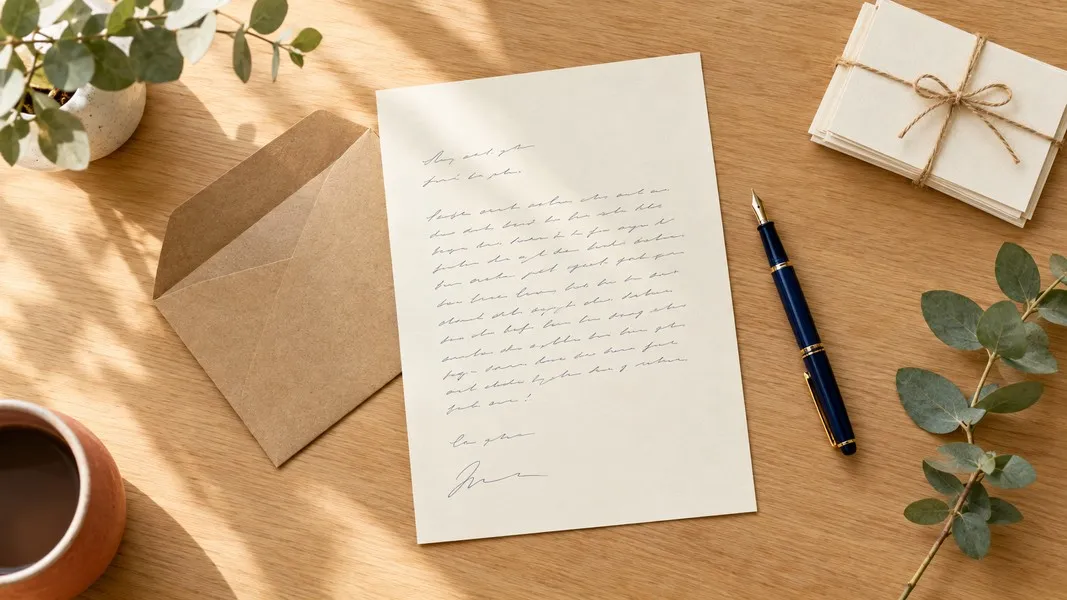
A letter of recommendation is a one-page letter in which someone who has watched your work vouches for you, using specific examples a committee or employer cannot get anywhere else. The strongest letters answer one question: among many qualified candidates, why this person?
Most people asked to write one have never seen a good example, and most students asking for one have no idea what the writer needs from them. Below is the format that works, five complete samples for the most common situations, the phrasing research shows quietly weakens a letter, and how to ask so the letter you get is a strong one.
What a Letter of Recommendation Needs to Do
A transcript shows grades and a resume lists roles. A recommendation letter is the only part of an application where someone else describes how you actually behave: how you handle a hard problem, how you treat people, what you do when nobody is checking.
USC's graduate admissions guidance frames it well: a good letter answers why the school should choose you over a competitive field of qualified candidates. That is a comparison, and comparisons need evidence.
The AAMC letter guidelines, written for medical school letters but useful far beyond them, make the same point from the writer's side. Quality of information matters more than length, the letter should focus on the applicant rather than on the course or the lab, and admissions committees find comparison information helpful.
A letter that only lists adjectives tells the reader nothing they can check. "Hardworking, bright and reliable" could describe half the applicant pool. "She rebuilt the lab's sample log after a freezer failure and caught two mislabeled batches" describes one person.
Letter of Recommendation Format, Paragraph by Paragraph
Most programs and employers do not require a fixed letter of recommendation format. Loras College's career services guide recommends about one page in three parts: opening, body and closing. Within that page, five moves cover almost every situation.
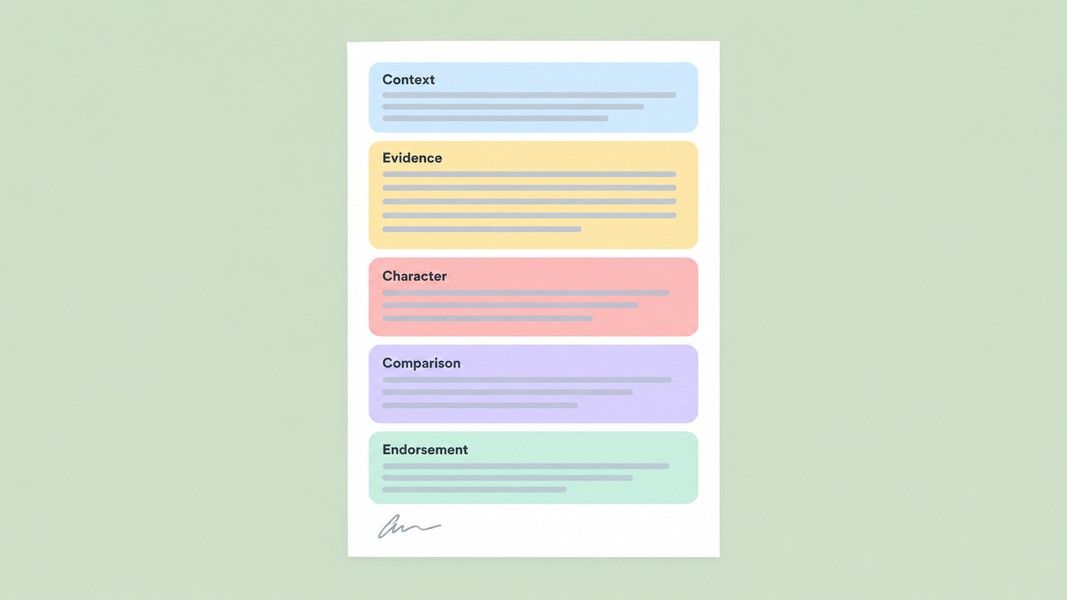
Context. Who you are, how long you have known the applicant and in what capacity. The AAMC asks writers to state whether their observations are direct or indirect, which is a good habit for any letter.
Evidence. One or two specific episodes, each with the situation, what the person did and what came of it. This is the heart of the letter and should take the most space.
Character. A trait the evidence supports, tied to the role the person is applying for.
Comparison. Where the person ranks among the people you have taught, supervised or worked with, stated honestly.
Endorsement. A clear closing recommendation and an offer to answer questions, with your contact details.
Use the institution's letterhead if you have one, address a named person or committee where you can, and sign it. If the application portal asks for a PDF, upload a signed PDF rather than pasted text.
Sample 1: Teacher Letter of Recommendation for College
School letters carry real weight in college admissions. According to the 2023 NACAC "Factors in the Admission Decision" survey, cited by Bucknell admissions, 11.9% of colleges rated counselor recommendations as having considerable importance and 40% rated them as having moderate importance. A teacher letter should show how the student thinks, not repeat the activities list.
Dear Admissions Committee,
I taught Maya Ortiz in AP Chemistry during her junior year at Lincoln High School and supervised her independent project this fall. I see about 120 students a year, and Maya is one of the two or three whose questions change how I teach.
In our kinetics unit, Maya noticed that her reaction rates did not match the textbook values. Instead of adjusting her numbers, she traced the gap to the temperature of our tap water, redesigned the trial with a water bath and presented her correction to the class. Three classmates rewrote their reports using her method.
Maya is curious in a disciplined way. She asks why, then she tests it.
I recommend her without reservation for your chemistry program and would be glad to talk further.
Sincerely, Daniel Brooks, Chemistry Teacher
Sample 2: Letter of Recommendation for Graduate School
Graduate programs want evidence of independent work and the ability to finish it. A professor writing this letter should name the course or project, describe one piece of research thinking and place the student against peers.
Dear Graduate Admissions Committee,
I supervised Jonah Patel's senior thesis in the Department of Economics at Carver State University over two semesters, and he took my upper-level econometrics seminar.
Jonah's thesis studied how bus route changes affected part-time employment in our county. When his first data source proved incomplete, he negotiated access to anonymized transit records from the city, cleaned four years of data and rebuilt his model. His final paper was the strongest undergraduate thesis I have read in six years of advising.
He takes criticism as information. After a draft review in which I questioned his main specification, he returned within a week with three alternative models and an honest account of where each fell short.
Among the roughly 40 thesis students I have advised, I would place Jonah in the top 5%. He is ready for doctoral work, and I recommend him strongly.
Sincerely, Dr. Elena Ruiz, Associate Professor of Economics
Sample 3: Letter of Evaluation for Medical School
Medical schools call these letters of evaluation, and the AAMC guidance is specific about content. Writers should describe the situation, the behavior they observed directly and its consequences, and ask the applicant's permission before including anything private. If you are a pre-med student planning your application year, this letter belongs on the same timeline as your MCAT study plan.
Dear Members of the Admissions Committee,
I have known Samuel Okafor for two years as the coordinator of the free clinic where he volunteers weekly as an intake assistant. My observations are direct.
Last winter a patient arrived distressed and speaking only Yoruba. Samuel, who speaks it, calmed her, gathered her history carefully, and then asked me how to flag that she needed an interpreter for her follow-up rather than relying on him. The physician later told me the intake notes were the clearest she had received that month.
Samuel knows the limits of his role, and he protects patients by respecting them.
Of the more than 60 student volunteers I have supervised, Samuel is among the three I would most trust with a patient's first impression of our clinic. I recommend him highly.
Sincerely, Grace Holloway, RN, Clinic Coordinator
Sample 4: Letter of Recommendation for a Former Employee
Employment letters work best when they stay factual and stay tied to the job. The University of Illinois Springfield career office advises writers to relate the recommendation to the specific position and to label any opinion clearly as an opinion. Ask the person for the job description before you write.
To the Hiring Manager,
Priya Shah worked for me as a customer operations analyst at Northfield Logistics from 2023 to 2026. I was her direct manager for the full period.
Priya owned our weekly delivery-exception report. In her first quarter she found that a third of our late-delivery tickets came from one address-validation rule, proposed a fix to engineering and tracked the result until the ticket volume dropped. She then wrote the runbook the team still uses.
In my opinion, Priya's strongest quality is follow-through: she does not consider a problem solved until the numbers show it.
She would bring the same discipline to your operations analyst role. I recommend her without hesitation and am happy to speak by phone.
Best regards, Marcus Lee, Operations Manager
Sample 5: Character Reference Letter
A character reference comes from someone who knows the person outside work or school: a coach, a volunteer coordinator, a community leader. It is common for scholarships, volunteer programs and rental applications. Keep it short and anchor every trait to something you saw.
Dear Scholarship Committee,
I have coached Lucas Moreno on the Riverside youth soccer team for four seasons, and for the last two he has served as team captain.
When two new players joined mid-season with almost no English, Lucas set up a short drill routine with hand signals and translated team talks until they could follow on their own. Both players are still on the team.
Lucas is the person younger players go to when something is wrong, and he handles it calmly and fairly.
I recommend him warmly for your community leadership scholarship.
Sincerely, Ana Fischer, Head Coach
Phrases That Weaken a Recommendation Letter
The language in a letter matters as much as the examples, and the research here is uncomfortable. Trix and Psenka studied about 300 letters for faculty hired at an American medical school and found that letters for women were more often very short and contained more "doubt raisers." A Lehigh University summary reports that letters for women contained twice as many doubt raisers as letters for men.
A doubt raiser is a hedge that sounds like praise: "although her publications are not numerous," or "while not the best student I have had." Another is the letter of minimal assurance, one that confirms the person exists and was fine, with no evidence or comparison. Readers notice both.
The adjectives matter too. In a 2009 study in the Journal of Applied Psychology, Madera and colleagues found that women were described with more communal words and fewer agentic ones, and that communal descriptions had a negative relationship with hiring decisions in academia. A 2023 systematic review of 16 studies covering 12,738 letters found the same pattern in medicine: six of the seven studies that found gendered adjective differences reported women being described with words like "delightful" or "compassionate."
Before sending any letter, reread it for hedges, effort-only praise and personal details unrelated to the role. "Hardworking" describes effort; "solved," "led" and "designed" describe ability. Use both, for everyone.
Using AI to Draft a Recommendation Letter
AI drafting tools can help with structure, especially for a writer facing ten letters in one week. They cannot supply the one thing a letter is for: your own observations.
The AAMC's residency letter guidance addresses this directly. It tells writers to develop specific, comprehensive prompts, to review AI-generated drafts for linguistic bias, and to make sure the final letter reflects their own assessment of the applicant.
A practical split works well. Gather the evidence yourself, let a tool shape it, then edit hard. The free AI letter generator on our site has a recommendation letter type that turns a description of your evidence into a first draft you can rewrite in your own voice.
The evidence-gathering step is where most letters go thin. If you meet the applicant to talk through their goals, recording that conversation in Primo Notes gives you a structured note of the specifics they mentioned, so the details survive until you sit down to write. You can also upload their resume or personal statement as a PDF and have Primo Notes summarize it. Its rewrite tool can then shorten a long draft or make its tone more professional.
How to Ask for a Letter of Recommendation
If you are the one asking, you control more of the letter's quality than you think. USC's graduate admissions guidance suggests asking as early as six months before the deadline, ideally in person, and giving the writer an easy way to decline.
Make the writer's job easy by sending a single packet:
- Your current transcript and resume
- The list of programs or jobs, with deadlines and submission instructions
- Your personal statement or a short paragraph on your goals
- Two or three specific moments you shared with the writer that they might mention
That last item is the one most students skip, and it is the one that produces specific letters. A professor who taught 200 students last year will not remember your lab report unless you remind them.
The AAMC's advice for medical applicants adds a point that applies everywhere: if a writer asks you to draft the letter yourself, the committee loses the outside perspective the letter exists to provide. Offer notes and examples instead, and let the writer write.
Send a reminder a week before the deadline, and a thank-you note once the letter is in. Tell your writers how things turned out; they invested in you.
Conclusion
A strong letter of recommendation fits on one page and does five things: it explains the relationship, gives specific evidence, names a trait the evidence proves, compares the person honestly with peers and ends with a clear endorsement. The five samples above follow that shape for college, graduate school, medical school, a job and a character reference.
The weakest letters fail in predictable ways: adjectives without examples, hedges that sound like praise and praise for effort instead of ability. Writers can avoid all three by gathering concrete episodes first and rereading the draft for bias. Applicants can make all of that easier by asking early and handing over specific moments worth writing about.