
A literature review is a structured account of what published research already says about a topic, organised by theme or argument rather than source by source, and ending with what is still unknown. You write one by defining a focused question, searching and screening sources, taking notes as you read, grouping the findings into themes, and writing paragraphs that compare sources instead of summarising them one at a time.
That last part is where most drafts go wrong. A first literature review often reads like an annotated list: one paragraph per article, in the order you found them. This guide walks through the seven steps, the structures that work, and a side by side example of summary versus synthesis so you can see the difference on the page.
What a Literature Review Is and What It Is Not
The University of Sheffield describes a literature review as an account of the current thinking in a specific area of study, written to show the reader what has gone before and to give you a foundation to build on. It can be a chapter of a dissertation, a section of a research paper, or a standalone assignment.
A literature review does not present new research; it organises and evaluates research that already exists. That is the line the psychology department at UC San Diego draws, and it explains why the writing feels different from an essay. Your argument comes from the pattern across sources, not from a single piece of evidence.
It is also not a bibliography. An annotated bibliography describes each source on its own, which is a useful step on the way, and you can see how those entries are built in this guide to writing an annotated bibliography. The literature review takes those notes and connects them.
The main types of review
Most coursework asks for a narrative review, sometimes called a traditional review. It describes and appraises published work without reporting exactly how sources were found, which is why the University of Ulster notes it cannot be replicated. Other types follow stricter rules:
- Systematic review: explicit eligibility criteria, a documented search, and reproducible methods meant to minimise bias, often ending in a meta-analysis.
- Scoping review: maps how much research exists on a question and where the gaps are, usually without synthesising conclusions.
- Integrative review: critiques and synthesises studies of different designs, experimental and non-experimental, to build a framework or model.
In a 2019 overview in the Journal of Business Research, Hannah Snyder adds a semi-systematic approach for broad topics that tracks how a research area developed over time. If your brief does not name a type, assume a narrative review and ask your instructor before adding a methods section.
How to Write a Literature Review in 7 Steps
Before you start, have three things ready: your assignment brief or research question, access to your library databases, and one place to keep notes on every source. The steps below follow the sequence used by UC San Diego and the eHealth evaluation handbook on NCBI Bookshelf, which lists question, search, screening, quality appraisal, extraction and analysis as the generic stages of any review.
Step 1: Narrow the topic into a question
A topic such as "social media and students" returns thousands of papers. A question such as "how does daily social media use relate to sleep quality in university students?" tells you what to search for and what to ignore. Write the question down, then list the keywords and synonyms you will search with.
Step 2: Search the literature
Run your keywords in the databases for your field, such as PsycINFO for psychology, PubMed for health, or your library's multidisciplinary search. Focus on peer-reviewed articles and use books for theory and background. Save each search string so you can repeat it, and keep full bibliographic details from the start, including page numbers, which the University of Canterbury's guide stresses because tracing a quote back later costs far more time.
Step 3: Screen what you found
Read titles and abstracts first and sort each result into keep, maybe, or drop. Ask whether it answers part of your question, whether it is recent enough for your field, and whether the method is sound. You will read far fewer full papers than you find, and that is the point of this step.
Step 4: Read and take notes as you go
Write notes while you read, not after. Marco Pautasso makes this his third rule in Ten Simple Rules for writing a literature review: by the time you finish reading, you already have a rough draft instead of a blank page. For each source, note the question it asked, the method, the main finding, its limitations, and how it relates to the other sources you have read. Put anything copied word for word in quotation marks so it never slips into your draft as your own wording.
If your sources arrive as PDFs, Primo Notes turns each upload into a titled, structured note, and its Ask AI chat lets you question that one paper about its method or sample before you write your own notes. Printed chapters from the library can go through the camera instead, which reads the page and turns it into a note in the same format.
Step 5: Build a synthesis matrix
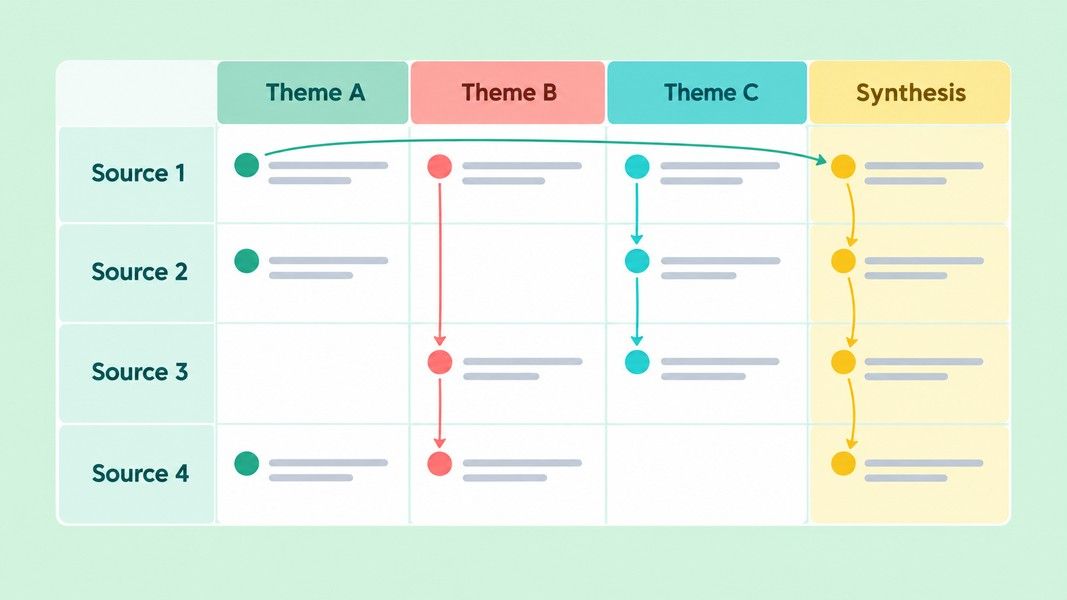
A synthesis matrix is a grid with your sources down one side and your themes across the top. Sheffield recommends it as the tool that reveals your structure: each cell holds what that source says about that theme, and a final column records how the sources compare. Once the grid fills, you can see which sources agree, which contradict each other, and which themes have little research behind them.
Step 6: Choose a structure and outline
Decide how the body will be organised, using one of the patterns in the next section, and write a heading for each theme. Under each heading, list the sources that belong there and one sentence that states your view of what they show together. That sentence becomes the topic sentence of the paragraph.
Step 7: Write, then revise for synthesis
Draft the introduction last if you get stuck there. In the body, each paragraph should make one point that draws on several sources. When you revise, read only the first sentence of each paragraph: if those sentences name authors rather than ideas, the paragraph is still summarising, and it needs rewriting around the idea.
How to Structure a Literature Review
The Purdue OWL breaks a literature review into the familiar three parts, each with a specific job.
The introduction states your topic and the question or thesis, previews the themes in the order they appear, and, for a standalone review, may explain how sources were found and selected. The body summarises, synthesises, interprets and evaluates, with each section built around a theme or a debate. The conclusion pulls together the key findings, explains their significance, and connects them back to your research question, usually by naming the gap your own work will address.
Ways to organise the body
Purdue lists four common patterns, and you can combine them:
- Chronological: traces how thinking on the topic changed over time. Useful when the history matters, but analyse turning points instead of listing studies by year.
- Thematic: groups sources by recurring theme or concept, regardless of when they were published. This is the default for most student reviews.
- Methodological: compares what different approaches found, such as qualitative against quantitative studies, or experimental against observational work.
A fourth, the theoretical pattern, is common in the humanities: the review compares theories, models and definitions to build the framework for your own study. Sheffield suggests ordering thematic sections from the broadest theme to the most specific, so the review narrows naturally toward your question.
Literature Review Example: Summary vs Synthesis
The fastest way to understand synthesis is to compare two versions of the same paragraph. The three studies below are invented placeholders, so the example shows the shape of the writing rather than real findings.
Summary version
Smith (2019) surveyed undergraduates and found that students who used social media after midnight reported worse sleep. Jones (2021) used sleep trackers with students and found no link between total screen time and sleep duration. Lee (2022) interviewed students, who described scrolling as a way to wind down.
Each sentence is accurate, and each describes one source. The reader has to work out what the three studies mean together.
Synthesis version
Evidence on social media and student sleep depends on what is measured. Self-report surveys link late-night use to poorer sleep quality (Smith, 2019), while tracker data finds no relationship between total screen time and sleep duration (Jones, 2021). The difference may lie in timing rather than volume, which interview data supports: students describe scrolling as part of winding down, not as a replacement for sleep (Lee, 2022). Few studies have compared timing and total use within the same sample, which leaves the mechanism unclear.
The synthesis version opens with an idea, uses every source as evidence for it, and ends by naming a gap. That pattern is what the University of Canterbury means when it says each body paragraph should make one point relevant to multiple sources. It also shows the reader you know the field well enough to sort it into a small number of themes.
Tips for Better Results
Keep the scope narrow
Pautasso notes that a short, focused review of recent work may attract more busy readers than a sprawling one, and the same logic applies to coursework: a narrow question covered well beats a broad one covered thinly.
Evaluate, do not only report
Purdue's guidance is to mention the strengths and weaknesses of your sources, not only their findings. A small sample, a self-report measure, or a study from one country are all limits worth naming, because they often explain why findings disagree.
Keep tense and voice consistent
Be consistent with tense and voice. Pautasso flags consistency, including the choice between present and past tense, as one of the features that makes a review readable. Many fields use the past tense for what a specific study found and the present tense for what the literature shows overall.
Keep every source in one format
If part of your reading is recorded, such as a lecture that frames the debate or a conference talk on YouTube, Primo Notes can turn the recording or link into a note and transcript, so those ideas sit in the same format as your reading notes. Its mind map tool can also lay out a single note as a branching outline, which helps when you want to see how one long paper divides into themes. To shorten a dense source before you take notes on it, these methods for summarising an article or chapter keep the key argument intact.
Troubleshooting Common Issues
You have too many sources
Go back to Step 1 and tighten the question. Add a population, a time frame, or a setting, then re-screen. If your brief sets a word limit, the number of sources you can discuss well is smaller than you think, because each needs room for evaluation, not only a mention.
The review reads like a list
This is the source by source problem. Rebuild the outline from your synthesis matrix's theme columns instead of your source list, then rewrite each paragraph so the first sentence states a claim. The University of Canterbury's guide is direct on this: discussing each source one by one leaves the review disjointed.
You cannot find a gap
A gap does not have to be a topic no one has studied. It can be a population that has not been sampled, a method that has not been tried, two findings that have not been reconciled, or evidence that is now dated. The scoping review exists for exactly this kind of mapping, and reading one in your field is a quick way to see where researchers say the gaps are.
Your sources disagree
Disagreement is material, not a problem. Group the sources by position, then look at what differs between them: method, sample, measure, or date. Explaining why studies disagree is often the strongest paragraph in the review.
Conclusion
A literature review is an argument built from other people's research. Start with a narrow question, search and screen with a record of everything you keep, and take notes while you read so the draft builds as you go. A synthesis matrix turns those notes into themes, and the themes become your structure, whether you order them chronologically, thematically, methodologically or by theory. In the writing, each paragraph should open with an idea, draw on several sources, and evaluate them. Close by connecting what the literature shows back to your question and naming what is still unknown.