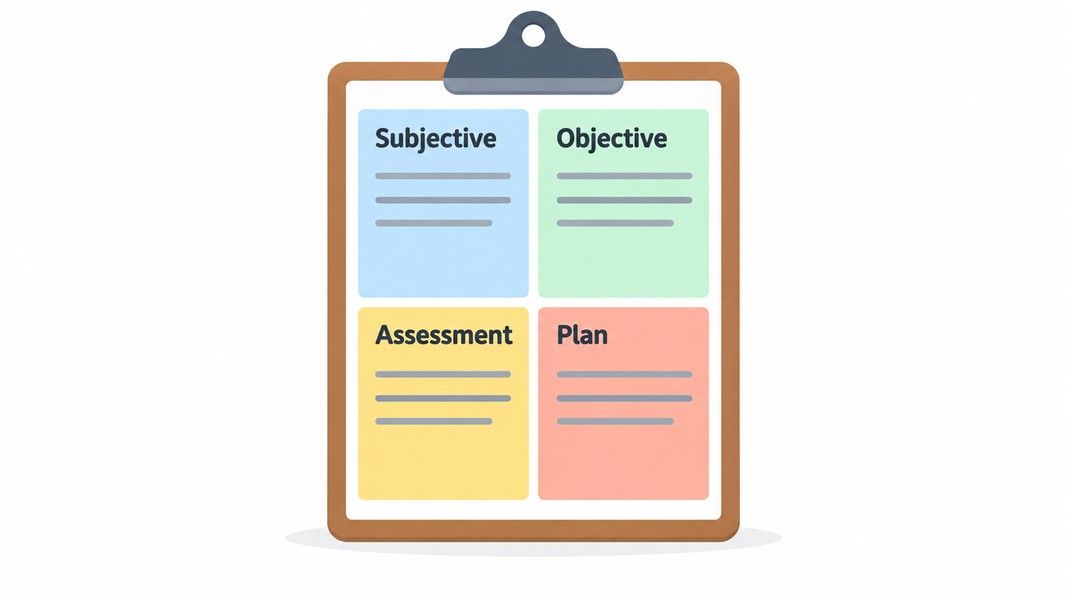
A SOAP note template splits every clinical note into four parts: Subjective (what the patient tells you), Objective (what you measure and observe), Assessment (what you conclude from both) and Plan (what happens next). The four headings stay the same across professions, but what goes under each one changes a lot between a nursing shift, a counseling session and a speech therapy visit.
If you are a nursing, therapy or pre-health student, that variation is what trips people up. Below are six formats with a filled-in example for each, plus the mistakes that most often weaken a note.
What a SOAP Note Template Contains
According to StatPearls clinical reference, the SOAP note works as a checklist, a cognitive aid and an index for finding information later. Each heading has a clear job.
Subjective holds the patient's own account: symptoms, feelings, history and concerns, ideally in their words. Objective holds data anyone could verify: vital signs, exam findings, test results, measured performance. Assessment is your synthesis of the first two into a problem or diagnosis. Plan lists tests, treatment, referrals, education and follow-up for each problem.
The line between subjective and objective is the one students blur most. StatPearls gives a clean example: a patient reporting stomach pain is a symptom and goes under Subjective, while abdominal tenderness on palpation is a sign you found, so it goes under Objective. Medications can sit in either section, but each entry needs the name, dose, route and frequency.
Where the SOAP Format Came From
The format traces back to Dr. Lawrence Weed, who first published on the problem-oriented medical record in 1964 and brought it to prominence in 1968 with his New England Journal of Medicine paper "Medical Records that Guide and Teach." In an interview published in the JAMIA journal, Weed is described as the inventor of the now ubiquitous SOAP note.
Weed's original progress note had five parts, not four: Subjective, Objective, Rx, Interpretation and Plan. It settled into the four-part version used today, and his problem list and SOAP format became a cornerstone of medical and nursing education.
That origin explains why the format feels the way it does. Weed wanted every note tied to a numbered problem, so a reader could open any record, find "Problem 3: Hypertension," and follow the plans and progress for that problem alone. Good SOAP notes still work that way.
SOAP Note Template for General Medical Visits
This is the base version, used in primary care, urgent care and most physician and nurse practitioner visits. It is also what people usually mean when they search for a free SOAP note template.
| Section | What goes here | Filled-in example |
|---|---|---|
| Subjective | Chief complaint, history of present illness, relevant history, medications, allergies | "Sore throat for 3 days, worse when swallowing." No fever at home. Takes no regular medications. No known allergies. |
| Objective | Vitals, exam findings, test results | T 38.1 C, HR 92, BP 118/76. Tonsils enlarged with exudate. Tender anterior cervical nodes. Rapid strep positive. |
| Assessment | Diagnosis or ranked problem list, with reasoning | Streptococcal pharyngitis, supported by positive rapid test, fever and exudate. |
| Plan | Treatment, tests, education, follow-up per problem | Antibiotic per protocol. Fluids, rest, analgesic as needed. Return if unable to swallow or symptoms persist past 48 hours on treatment. |
For a nurse practitioner SOAP note template, the structure is identical. What changes is depth: the Assessment usually ranks several problems, and the Plan numbers its actions to match each one, as Weed intended.
Nursing SOAP Note Template: The SOAPIE Format
Many nursing programs teach SOAPIE, which adds two headings to the end: Intervention (what you actually did, with times) and Evaluation (whether it worked). Some settings add an R for Revision, making SOAPIER.
The extra headings close the loop on a shift. A plan says what you intend; intervention and evaluation prove what happened. In nursing notes the Assessment is a nursing problem, such as acute pain or risk for falls, rather than a medical diagnosis.
| Section | Filled-in example |
|---|---|
| Subjective | "My incision hurts, about a 7 out of 10." |
| Objective | Post-op day 1. BP 132/84, HR 96. Dressing dry and intact. Guarding abdomen when turning. |
| Assessment | Acute pain related to surgical incision. |
| Plan | Give prescribed analgesic, reposition, reassess pain in 30 to 60 minutes. |
| Intervention | 14:10 analgesic given as ordered. Repositioned with pillow splinting. |
| Evaluation | 14:50 patient rates pain 3 out of 10, resting comfortably. Continue plan. |
Write the intervention and evaluation with times, because those are the lines another nurse will rely on at handoff. If your program uses a different charting style, the logic still applies: data, judgment, action, result.
Mental Health SOAP Note Template for Therapists
Counselors, psychologists and social workers use SOAP notes too, but the Objective section looks different because there is rarely a lab value to report. It holds what you observed: appearance, affect, behavior, speech, engagement, and the results of any standardized screening you gave.
| Section | Filled-in example |
|---|---|
| Subjective | Client reports sleeping 4 to 5 hours a night and "dreading" work meetings. Used breathing exercise twice this week. |
| Objective | On time, casually dressed. Affect anxious, speech slightly rapid. Engaged throughout session. |
| Assessment | Anxiety symptoms persisting, with partial use of coping skills. Sleep is the main barrier to progress this week. |
| Plan | Continue weekly sessions. Introduce a sleep routine and practice the breathing exercise before meetings. Review in next session. |
Some therapy settings prefer DAP notes (Data, Assessment, Plan), which merge Subjective and Objective into one Data section. Others use BIRP (Behavior, Intervention, Response, Plan), common in behavioral health because it ties each intervention to the client's response. If your placement uses one of these, the same discipline holds: keep what the client said separate from what you saw, and keep both separate from your interpretation.
SOAP Note Template for Occupational Therapy
Occupational therapy notes center on function: what the client can and cannot do in daily activities. The AOTA documentation guidance describes documentation as showing the depth and breadth of services delivered and the client's response to them, so your Objective section should show both what you did and how the client performed.
| Section | Filled-in example |
|---|---|
| Subjective | Client states, "Buttons are the hardest part of getting dressed." |
| Objective | Upper body dressing with minimal assist. Fastened 3 of 6 buttons independently in 4 minutes using a button hook after demonstration. |
| Assessment | Fine motor coordination improving; adaptive equipment increases independence. Progressing toward dressing goal. |
| Plan | Continue fine motor training 3 times weekly. Trial larger buttons on home clothing. Caregiver education next session. |
The phrase that separates a strong OT note from a weak one is the link to a goal. "Worked on buttons" tells a reviewer nothing; "3 of 6 buttons, up from 1 of 6 last week" shows progress toward a stated outcome.
Physical Therapy SOAP Note Template
Physical therapy notes are the most numbers-heavy of the six. The Objective section carries range of motion, strength grades, gait distance, assistive device use and the exercises given with sets and reps.
| Section | Filled-in example |
|---|---|
| Subjective | Patient reports knee pain 4 out of 10 after stairs, down from 6 last week. Completed home exercises daily. |
| Objective | Right knee flexion 0 to 105 degrees. Quad strength 4 out of 5. Ambulated 150 feet without device. Exercises: quad sets, heel slides, mini squats, 3 sets of 10. |
| Assessment | Range and strength improving; stair tolerance still limited. Patient on track for return to community walking. |
| Plan | Progress to step-ups next visit. Continue 2 times weekly. Update home program. |
Massage therapists use a lighter version of the same physical therapy SOAP note template: client-reported pain and goals under Subjective, palpation findings and areas treated under Objective, response to treatment under Assessment, and frequency and self-care advice under Plan.
Speech Therapy SOAP Note Template
The ASHA practice portal notes that the SOAP format is commonly used for speech-language pathology treatment notes, and its sample subjective line is simple: "Client reports completion of practice voice exercises." Objective data should include measurable statements about patient performance and what the clinician did in response.
| Section | Filled-in example |
|---|---|
| Subjective | Parent reports child practiced /s/ words at home 4 of 7 days. |
| Objective | Produced /s/ in initial position of words with 80% accuracy given minimal verbal cues, up from 60% last session. |
| Assessment | Steady progress toward word-level goal. Ready to begin phrase-level practice. |
| Plan | Introduce /s/ in short phrases. Continue twice weekly. Send home word list. |
Two details from ASHA matter for SLP students heading into medical settings. A treatment note using timed codes should record total treatment time, and Medicare progress notes must be written at or before every tenth session.
SOAP vs APSO: When to Change the Order
The SOAP order is not fixed. StatPearls cites a study in which the Assessment, Plan, Subjective, Objective order was superior to the usual SOAP order for speed, task success, accuracy and usability, when clinicians needed information for a typical chronic disease visit in primary care.
APSO puts the conclusion first, which helps the next reader. The content does not change, only where a busy reader lands. If your program or facility uses APSO, write the same four sections and move the bottom half to the top.
StatPearls also names a real weakness of the format: it has a limited ability to document changes over time. That is why strong notes compare today's data to the last session, as the OT, PT and SLP examples above all do.
Common SOAP Note Mistakes
Documentation takes real time once you are in practice. In a 2016 time-motion study of 57 physicians, 27.0% of the office day went to direct clinical face time and 49.2% to electronic health record and desk work, and physicians who kept diaries reported 1 to 2 more hours of after-hours work each night. Getting the structure right while you are still a student saves you rewriting later.
The mistakes that come up again and again:
- Opinions in the Objective section: "Patient seems depressed" is an assessment. "Flat affect, minimal eye contact" is objective.
- An Assessment that repeats the data: Restating vitals is not synthesis. Say what the findings mean and whether the patient is improving.
- A Plan with no specifics: "Continue treatment" needs frequency, next step and the condition that would change the plan.
- No comparison to last time: Without a baseline, a reader cannot tell progress from decline.
- Vague medication entries: Name, dose, route and frequency, every time.
How to Practice SOAP Notes as a Student
The fastest way to learn the format is volume: write a note for every case study, simulation and lecture example, then compare it against a model answer. Sorting a case's details into four buckets is the same skill as any structured note, and the note taking template guide covers how layouts like this shape what you remember.
Primo Notes can help with the study side. Record a documentation lecture or a simulation debrief and it comes back as a structured note with a transcript, and the flashcard and quiz tools turn it into practice on which details belong under which heading. Handwritten practice notes from a skills lab can be photographed, since camera OCR turns them into text you can review.
To test your clinical reasoning, Primo Notes also has a Feynman mode, a guided spoken session where you explain a case out loud and the app works the gaps. If you cannot explain why your assessment follows from your data, the note is not ready.
One rule overrides everything here: real patient information belongs only in the record system your program or facility approves. Practice on de-identified cases and simulations, never on recordings of real patients. Nursing students preparing for licensure can fold this practice into an NCLEX study plan.
Conclusion
Every SOAP note template rests on the same four questions: what the patient reports, what you can verify, what it means and what happens next. The professions differ in the details. Nursing adds Intervention and Evaluation, therapists document affect and engagement, OT ties everything to function, PT leans on measurements, and speech therapy reports accuracy against cues.
Keep subjective and objective apart, make the assessment a real synthesis, give the plan specifics, and compare each note to the last one. Those habits carry across every format and every setting you will document in.