
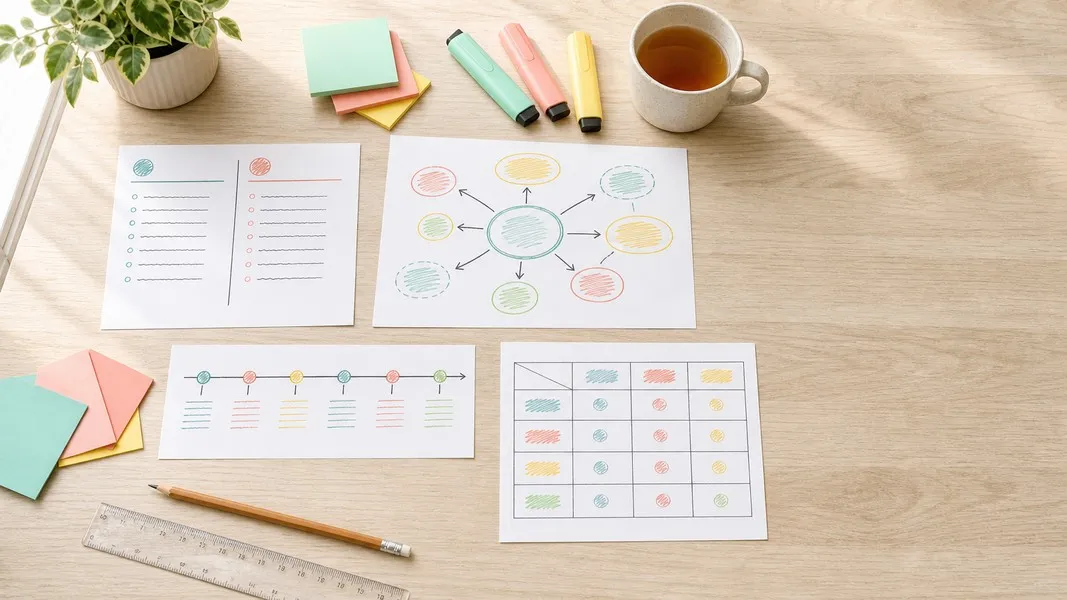
A study guide template is a fixed layout you fill in for every unit, so your review material always has the same shape and you spend your time studying instead of formatting. The best one depends on the subject: an outline suits narrative courses, a question and answer layout suits fact-heavy exams, and a formula sheet suits problem sets.
Most students pick a template because it looks clean. The better test is what the layout makes you do when you open it a week before the exam. A page you can only reread will feel productive and teach you little. A page that forces you to answer, connect or compare will do the work for you.
Below are six formats, each shown with a short filled example, plus guidance on which subjects they fit and how to build them in Google Docs, Word or on paper.
What a Good Study Guide Template Does
The strongest evidence on study methods comes from a 2013 review led by John Dunlosky that rated ten common techniques by how well they hold up across students, materials and tests. Practice testing and distributed practice earned the only high utility ratings. Summarization, highlighting and rereading were rated low, according to the Dunlosky review, which also gave elaborative interrogation, self-explanation and interleaved practice a moderate rating.
That ranking is a useful filter for any template. A study guide earns its place when it turns your notes into something you can test yourself on, spread over several sessions. A layout that only condenses the chapter into a shorter version of itself is summarization with nicer margins.
So every format below is built around one of the higher rated activities. Three questions help when you judge a template you found elsewhere:
- Can you cover half the page and quiz yourself with the other half?
- Does it make you explain why something is true, not just state it?
- Does it put similar ideas side by side so you have to tell them apart?
If the answer to all three is no, the template is a nicer place to store notes, not a study tool.
How to Pick a Study Guide Template by Subject
Match the format to the kind of question your exam asks. A history final that asks you to explain causes needs a different layout from a chemistry exam full of calculations.
| Subject type | Typical exam question | Best format |
|---|---|---|
| History, politics, literature | Explain, trace, argue | Outline or timeline |
| Biology, anatomy, psychology | Define, identify, describe | Question and answer or concept map |
| Economics, sociology, law | Compare, distinguish, apply | Comparison chart |
| Math, physics, chemistry | Solve, calculate | Formula and problem sheet |
| Languages | Translate, recall vocabulary | Question and answer |
Many courses mix question types, so it is normal to combine two formats in one guide. A biology unit might use a concept map for a process and a question and answer page for terms.
1. Outline Study Guide Template
The outline format arranges a unit as a hierarchy: main topics, the points under them, and the evidence under those. It is the closest to how a lecture is usually delivered, which makes it the fastest to fill in from class notes.
A filled example for a history unit looks like this:
| Level | Entry |
|---|---|
| Topic | Causes of World War I |
| Main point | Alliance system |
| Detail | Triple Entente and Triple Alliance turned a regional crisis into a continental war |
| Why it matters | Explains how one assassination drew in most of the great powers |
| Main point | Militarism |
| Detail | Mobilization plans assumed speed, so delay looked like defeat |
The "why it matters" line is what keeps an outline from becoming a summary. Asking why each point is true is elaborative interrogation, one of the moderate utility techniques from the review above, and it gives you something to explain rather than recognize.
To study from an outline, cover everything below a main point and try to rebuild it from memory. If you have used the outline method for notes, this will feel familiar; the difference is that a study guide version keeps only what is likely to be tested.
2. Question and Answer Study Guide Template
The question and answer layout splits each page into two columns: questions on the left, answers on the right. It is the most direct way to build practice testing into a study guide, because the page is already a quiz.
| Question | Answer |
|---|---|
| What does the mitochondrion produce? | Most of the cell's ATP through cellular respiration |
| Where does glycolysis happen? | In the cytoplasm, not the mitochondrion |
| Why does the inner membrane fold into cristae? | More surface area for the electron transport chain |
The research behind this format is strong. In a well-known experiment by Roediger and Karpicke, students read prose passages and then either restudied them or took recall tests. On a test five minutes later, restudying looked better. On the tests two days and one week later, prior testing produced substantially greater retention, even though the restudy group felt more confident.
That confidence gap is the trap this template protects you from. Write questions in the form your exam uses, keep answers short enough to check at a glance, and always answer before you look.
3. Concept Map Study Guide Template
A concept map places key terms in boxes and connects them with labeled arrows that say how they relate. It fits any topic where the relationships matter more than the list of terms: biological processes, economic systems, the structure of an argument.
A filled example for the water cycle uses evaporation, condensation, precipitation and collection as nodes, linked by arrows labeled "heat from the sun drives", "cooling air causes" and "gravity returns water to". The arrow labels are the part that gets tested, so never leave one blank.
A 2018 meta-analysis of 142 effect sizes from 11,814 participants found that learning with concept maps produced a moderate benefit. The more useful finding for a study guide is the split: creating concept maps was associated with a larger effect than studying maps someone else made, and the benefit held in both STEM and non-STEM subjects.
Build the map yourself, then redraw it from memory before the exam. Comparing your redrawn version with the original shows exactly which links you have lost. In Primo Notes, the mind map tool can turn a recorded lecture into a first draft of the structure, which you then rebuild and label by hand.
4. Comparison Chart Study Guide Template
The comparison chart puts similar concepts in columns and the features that distinguish them in rows. It is the format for any exam that asks you to tell close ideas apart: types of market structure, classes of drugs, legal doctrines that sound alike.
| Feature | Mitosis | Meiosis |
|---|---|---|
| Purpose | Growth and repair | Producing gametes |
| Divisions | One | Two |
| Daughter cells | Two, identical | Four, genetically different |
| Chromosome number | Stays the same | Halved |
The chart works because it makes you discriminate. Research on interleaving, where similar problem types are mixed rather than practiced in blocks, points the same way. A 2021 research summary on interleaving notes that more than a dozen randomized studies compared interleaved and blocked math practice, and each found that more interleaving produced higher final test scores.
To study from the chart, hide one column and fill it in, or read a row label and name which concept it belongs to before checking.
5. Timeline Study Guide Template
The timeline format lists events or stages in order, with a cause or consequence beside each one. It suits history, but also any process with a fixed sequence: the stages of a clinical trial, the steps of a legal case, the phases of a project.
| Date or stage | Event | Consequence |
|---|---|---|
| 1914 | Assassination in Sarajevo | Austria-Hungary issues an ultimatum to Serbia |
| 1917 | United States enters the war | Fresh troops shift the balance on the Western Front |
| 1919 | Treaty of Versailles | Reparations and territorial losses for Germany |
The consequence column is what makes this a study guide rather than a list of dates. Exams rarely ask what happened in a year; they ask why it led to the next thing.
Test yourself by covering the middle column and reconstructing events from the dates, then by covering the dates and putting events in order. Both directions come up in exams.
6. Formula and Problem Sheet Template
For math and the sciences, the most useful study guide is a sheet of formulas paired with problems that use them. Each row gives the formula, what each symbol means, when to use it, and one worked example.
| Formula | When to use it | Worked example |
|---|---|---|
| v = d / t | Constant speed problems | 120 km in 2 hours gives 60 km/h |
| F = m × a | Net force on an object | 3 kg accelerating at 2 m/s² needs 6 N |
| PV = nRT | Ideal gas at stated conditions | Solve for n when P, V and T are given |
The "when to use it" column matters most, because on an exam the hard part is rarely the arithmetic. It is recognizing which formula a word problem calls for.
Add a second page of mixed problems with no labels, taken from past homework or the textbook's review section. Working through them shuffled, rather than chapter by chapter, is the interleaving practice that the research above supports.
Study Guide Template for Google Docs, Word or Paper
Every format above can be built with a table, which makes them easy to reproduce in any tool.
In Google Docs or Word, insert a table with the column headers shown in each example and save the file as your own template, so each new unit starts from the same layout. In Google Docs, keep a master copy and make a copy of it for each unit. In Word, save the file as a template so new documents open with the table already in place.
On paper, a ruled page folded down the middle gives you a question and answer layout with a built-in cover. A page turned sideways works better for a comparison chart or timeline. A blank page suits a concept map, since you need room to move boxes around.
Printable versions have one advantage worth keeping: you cannot copy and paste into them. Writing each entry by hand forces you to decide what matters, which is the first round of studying.
Filling a Template from Lectures and Readings
The slow part of any study guide is not the layout, it is pulling the content out of hours of lectures and chapters. That is where most guides stall.
Primo Notes handles the capture step. You can record a lecture, photograph handwritten notes or a textbook page, upload a PDF or slides, or paste a YouTube link, and each comes back as a structured note with a transcript. From that note, the quiz and flashcards tools give you a ready draft for the question and answer format, and the mind map tool gives you a starting point for a concept map.
For a quick start without an app, the free AI study guide maker turns pasted notes into a study guide you can then reshape into one of the formats above. If you want the full process from blank page to finished guide, the step by step guide on how to make a study guide covers it.
Treat whatever a tool generates as a draft. Rewriting the questions in your own words and checking each answer against the source is part of the learning, not extra work.
How to Use a Finished Study Guide
A completed template is only useful if you return to it. The Dunlosky review rated distributed practice as highly as practice testing, which means a study guide works best spread across several short sessions instead of one long one before the exam.
A simple schedule is to finish the guide for each unit within a few days of the lecture, then review it again a few days later, and again the week before the exam. Each time, test yourself first and only read what you got wrong.
Mark the entries you miss. By the third session, the guide should have shrunk to a short list of weak spots, and that list is what you study in the final days.
Conclusion
A study guide template saves you from rebuilding your review material from scratch every unit, but the layout you choose decides how much it helps. Pick the outline or timeline for subjects built on explanation and sequence, the question and answer page or concept map for definitions and processes, the comparison chart for concepts that are easy to confuse, and the formula sheet for problem-based courses.
Whatever the format, the guide works when it makes you retrieve rather than reread: covered columns, redrawn maps and shuffled problems. Fill it in close to the lecture, test yourself from it across several sessions, and let the entries you keep missing decide what you study last.