A lab report template is the fixed order of sections every experiment write-up follows: title page, abstract, introduction, methods, results, discussion, conclusion, references and appendices. Most science courses build on the same core, known as IMRaD (Introduction, Methods, Results, and Discussion), and then add rules of their own for citations, abstract length and tense.
That last part is where marks disappear. A psychology report in APA style, a chemistry report in ACS style and a physics report modelled on a journal article share a skeleton but differ in the details instructors grade. This guide gives you the standard template section by section, then the four discipline versions, and the writing order that makes the whole thing faster.
The Standard Lab Report Template, Section by Section
The Texas A&M Writing Center describes IMRaD as the format that lets a reader identify your methods and findings, replicate the experiment and place it in a larger body of research. It also notes that some lab reports carry requirements this format does not cover, so your assignment sheet or a sample report always wins over any general template.
Here is the full structure most undergraduate courses expect.
| Section | What goes in it | Tense |
|---|---|---|
| Title page | Experiment title and number, your name, partners, date, course | n/a |
| Abstract | Purpose, method, key results, main conclusion | Past |
| Introduction | Background, theory, purpose, hypothesis | Present for theory, past for your aim |
| Materials and methods | What you actually did, in enough detail to repeat it | Past |
| Results | Data, tables and figures, no interpretation | Past |
| Discussion | What the results mean, error sources, comparison to theory | Mixed |
| Conclusion | Whether the purpose was met, in a few sentences | Past and present |
| References and appendices | Sources in one consistent style, raw data, sample calculations | n/a |
Title Page and Abstract
The title page carries the experiment's name and number, the names of everyone in your group, and the date. The University of Toronto's lab report guide recommends titles that are straightforward, informative and under ten words. A title such as "Lab 4: Isolation of Caffeine from Tea Leaves" tells the grader exactly what follows.
The abstract is the whole report compressed. Length varies more than students expect: MIT's 5.310 chemistry lab asks for only two to four complete sentences that report the major results, numeric ones especially, while APA style caps an abstract at 250 words. Write the abstract last, once you know what your results actually say. Texas A&M suggests building it from simplified sentences taken from each IMRaD section.
Introduction
The introduction answers why the experiment was done. Give the background a reader needs, the theory or prior research the experiment tests, and the specific purpose or hypothesis. Keep it focused on this experiment rather than the whole topic.
A useful tense rule comes from the Lewis University Writing Center's chemistry guide: describe scientific concepts in the present tense and your own work in the past tense. "Enzymes lower activation energy" is present; "we measured reaction rates at five temperatures" is past.
Materials and Methods
This section records what you did so someone else could repeat it. Describe what actually happened in the lab, not the idealized procedure from the manual. The MIT report format makes exactly this point, and it is the most common gap between a manual and a report.
Bates College's biology writing guide adds that methods are not a step-by-step directive protocol, and that standard techniques such as serial dilution do not need explaining. Skip common sense steps like labeling tubes. Note quantities with units, equipment models where they matter, and any change you made mid-experiment.
Results
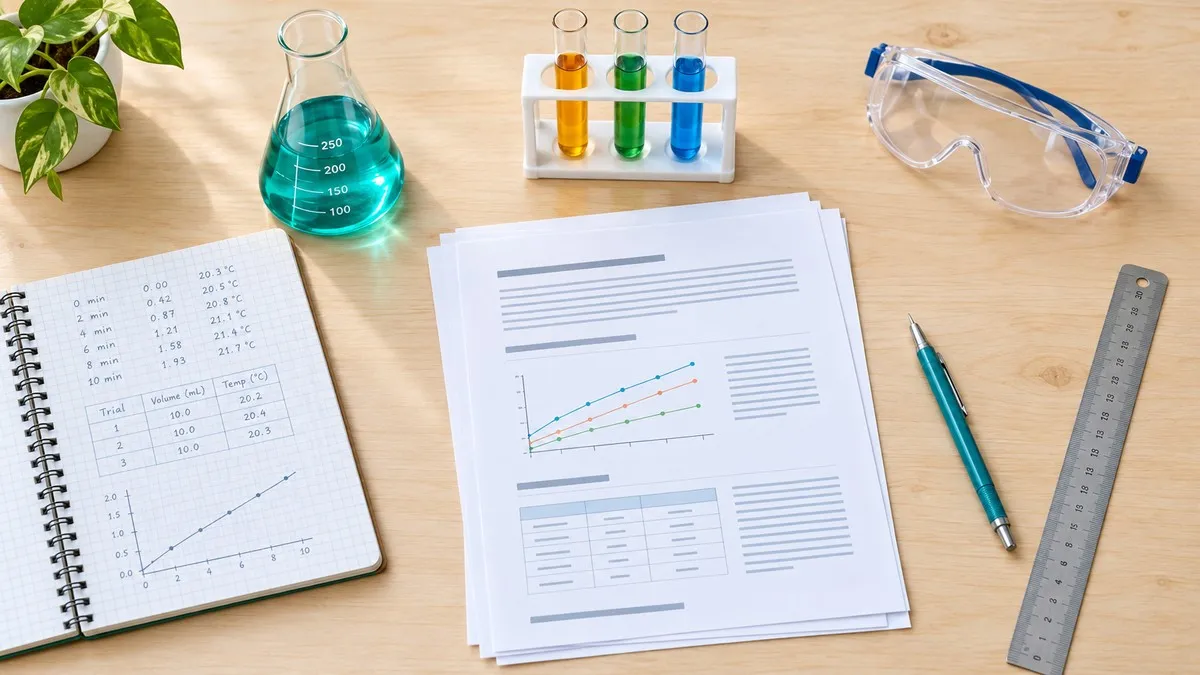
Results present the data and nothing else. Put numerical data in tables or graphs, then write a short text that walks the reader through what they show, referring to each one as "Table 1" or "Figure 2".
A guide from the University of Sussex psychology department sets a good test: the results text should make sense without the tables, and each table or figure should make sense without the text. Number tables and figures separately, so a report with three graphs and two tables has Figures 1 to 3 and Tables 1 to 2. Save every interpretation for the next section.
Discussion and Conclusion
The discussion is where you show that you understood the experiment. Texas A&M frames it as explaining whether the objectives in your introduction were met or the hypothesis was supported. Compare your values to accepted ones, name the likely error sources, and explain any result that surprised you.
Southern Illinois University's writing center calls the discussion the longest and most important section of the report. MIT's chemistry course adds a detail many students miss: answer the questions from the lab manual inside the discussion as connected prose, not as a numbered list of answers. The conclusion then states in a few sentences whether the purpose was achieved and what the result means.
References and Appendices
Cite every source you used, including the lab manual and any textbook derivation. The University of South Carolina's physics department puts it bluntly: whatever is not referenced is presumed to be your work. Appendices hold raw data, long calculations and anything that supports the report without belonging in its main flow. Label each item so the reader can find it.
APA Lab Report Template for Psychology
Psychology and other social science courses usually want APA style, and APA changes several details of the standard template.
The introduction carries no "Introduction" heading. Instead, the paper's title is repeated, centered and bold, on the first line of the first text page. Method, Results and Discussion then follow as Level 1 headings. The Method section usually splits into three subsections: Participants (who took part, how many, how they were recruited), Materials, and Procedure.
APA's own abstract guide limits the abstract to 250 words, with one or two sentences each on the problem, hypothesis, method, results and implications. The same guide notes that abstracts are not typically required for student papers, so check your assignment before writing one. Student papers in APA 7 also drop the running head unless the instructor asks for it.
Tables and figures follow fixed placement rules. The University of Washington's psychology writing center notes that table captions go above the table and figure captions below the figure, each with an Arabic number and a specific description.
Chemistry Lab Report Template (ACS Style)
Chemistry departments usually follow the ACS Style Guide from the American Chemical Society. The Truman State University chemistry lab lists the full ACS order: title, abstract, introduction, experimental (sometimes called materials and methods), results, discussion, conclusions, acknowledgements, references, then tables, schemes, figure legends, figures and supporting information.
The experimental section in chemistry tends to read like a published synthesis: reagents with amounts, reaction conditions, yields and the characterization data you collected. References default to the format of the Journal of the American Chemical Society unless your instructor names another journal.
Voice rules vary by course. MIT's chemistry course allows the first person where it makes a sentence clearer, and points students to the ACS Style Guide for grammar and word usage questions. Some chemistry courses also merge results and discussion into a single section, and the Lewis University guide accepts either layout.
Biology Lab Report Template
Biology lab reports usually follow the journal article format most closely. Bates College's biology department tells students to treat its writing guide as the "instructions to authors" a journal would issue, which captures the expectation: write the report as if submitting it for publication.
That guide recommends an abstract of about 200 to 300 words at most, with two or three sentences per part of the paper. Methods are written as prose, not a numbered protocol, and specific results appear in the results text with a reference to the relevant table or figure. In manuscripts such as lab reports, tables and figures typically sit on separate pages from the text.
Figure legends carry real weight in biology. A grader should understand a graph from its legend alone: what was measured, under what conditions, and what the error bars represent. Mention the sample size there too, since biology data often comes from repeated trials or several organisms.
Physics and Engineering Lab Report Template
Physics and engineering reports keep the IMRaD core but put more weight on equipment, uncertainty and analysis. The University of Toronto guide lists methods and materials (or equipment) and the experimental procedure as separate components, followed by results, discussion, a separate conclusion, references and appendices.
The same guide notes that lab reports are the most frequent kind of document written in engineering and can count for as much as 25% of a course. That share is why a consistent template pays off: you write the same structure dozens of times across a degree.
Physics instructors usually want uncertainties stated and carried through the analysis. The University of South Carolina's physics department asks students to state what was learned and discuss the uncertainties, and to cite in a consistent scientific style such as the AIP Style Manual. Page limits are common and strict; a Cambridge computer science lab module caps reports at 8 pages excluding references and appendices, and pages beyond the limit are not assessed.
How the Four Lab Report Formats Compare
| Format | Abstract | Methods structure | Citation style |
|---|---|---|---|
| APA (psychology) | Up to 250 words, often optional for students | Participants, Materials, Procedure | APA 7 |
| Chemistry (ACS) | Short, stating the major results | Experimental, written like a synthesis | ACS or JACS |
| Biology | About 200 to 300 words at most | Prose, standard techniques not explained | Instructor or journal style |
| Physics and engineering | Varies by course, sometimes omitted | Equipment and procedure, with uncertainties | AIP or a consistent scientific style |
If your course gives no citation format at all, Germanna Community College's formal lab report handout recommends defaulting to APA citations.
Write the Sections in This Order, Not Front to Back
The template's reading order is not the best writing order. The Truman State chemistry guide suggests composing in this sequence instead: materials and methods, then figures, figure legends and tables, then results, discussion, conclusions, introduction, abstract, and finally the title.
The logic is simple. Methods are fresh in memory and need no interpretation. Building figures next forces you to decide what the data shows before you describe it. The introduction and abstract come last because only then do you know what they need to set up and summarize.
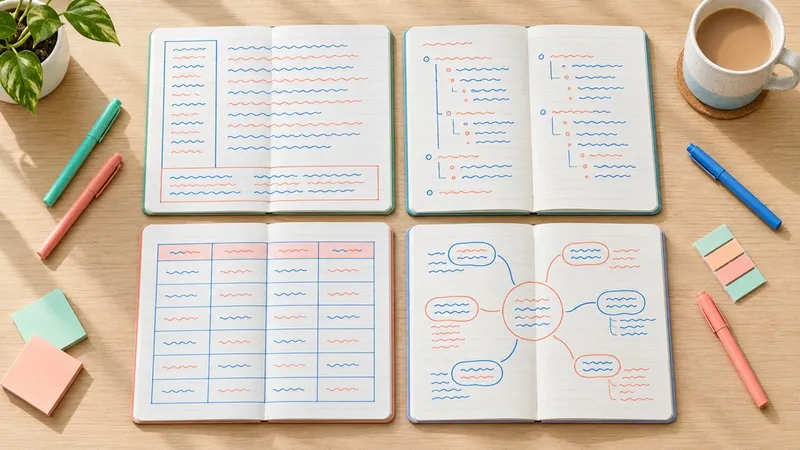
Methods are easiest to write from good raw notes. If your lab notebook entries are handwritten, Primo Notes can photograph each page and turn the handwriting into a typed note, so your observations, deviations and measurements are searchable when you sit down to write. A consistent page layout helps too; the split and outline styles in this note taking template guide adapt well to a lab notebook.
Setting Up a Lab Report Template in Google Docs or Word
A lab report template in Google Docs or Word is simply a file with the headings already in place. You can build your own in a few minutes and reuse it all semester.
Create a new document and add each section name as a heading using the built-in heading styles, not bold body text. Heading styles give you a navigable outline in the sidebar, which makes jumping between results and discussion much faster. Under each heading, add a one-line reminder of what belongs there and which tense to use, then delete those reminders as you write.
Set the formatting your course requires once, in the template itself: font, spacing, margins and page numbers. For an APA template, put the title page on its own page and start the text page with the repeated title. For a chemistry template, add a table with columns for reagent, amount and moles under the experimental heading. Save the file as a template or a master copy, and duplicate it for each new lab.
Lab Report Mistakes That Cost Marks
Most deductions come from a short list of habits that are easy to fix once you know them.
- Copying the manual's procedure. Methods should describe what you did, including what went wrong, in past tense.
- Interpreting in the results. Results report data; the discussion explains it.
- Unnumbered or untitled figures. Every table and figure needs a number, a descriptive caption and a mention in the text.
- Qualitative language. Southern Illinois University's guide asks for quantitative words, "3 mL" instead of "a small amount".
- Answers as a list. Fold the manual's questions into the discussion as prose.
- A first-draft abstract. An abstract written before the results is usually wrong by the end.
Texas A&M also recommends a direct, simple style that puts the focus on the work rather than on you as the person doing it.
Accurate methods depend on capturing what happened at the bench. Some students record the instructor's pre-lab briefing and their own spoken observations during the experiment; Primo Notes transcribes the recording into a structured note, which makes it easier to spot a step you changed. When a draft runs long, its rewrite tool can shorten or simplify a paragraph you wrote, and the summarizing techniques that work for readings apply directly to drafting an abstract.
Conclusion
A lab report template is the same IMRaD skeleton in every science: title page, abstract, introduction, methods, results, discussion, conclusion and references. The differences between APA, chemistry, biology and physics sit in the details: whether an abstract is required and how long it runs, how methods are structured, and which citation style applies.
Write methods first while the experiment is fresh, build your figures before describing results, and leave the introduction and abstract for last. Keep results free of interpretation, put your analysis and error sources in the discussion, and check the assignment sheet before trusting any general template, including this one.