
A flow state is a period of deep, absorbed focus in which a hard task feels almost effortless, time seems to change speed, and you stop noticing yourself. Psychologist Mihaly Csikszentmihalyi described it in 1975 while studying why people do demanding things for no reward beyond the activity itself.
If you have ever looked up from an essay or a problem set and realised two hours had passed, you have felt it. The harder question is how to get back there on purpose. This guide covers what flow means, what the research actually supports, what happens in the brain, and the conditions you can set up so flow is more likely when you sit down to study or work.
What Is Flow State?
The current research definition is short. A 2024 framework paper in Communications Psychology, written after 50 years of refinement of the idea, defines flow as "an intrinsically rewarding state of absorption in a task in which control feels effortless."
Three parts of that sentence matter. Flow is absorption, not just attention: the task fills your awareness so completely that there is little room left for worry or self-monitoring. It is intrinsically rewarding, so the activity feels worth doing for its own sake. And control feels effortless, even though the task is demanding.
That last point separates flow from ordinary concentration. Forcing yourself through a dull reading with willpower is focus. Flow is the state where the willpower drops out of the picture because the task is pulling you along.
Flow state meaning in everyday use
Outside psychology, "flow state" has become shorthand for being locked in: a gamer on a winning streak, a musician improvising, a developer who has not checked their phone in an hour. The everyday meaning is close to the research one. The difference is that researchers treat flow as something that depends on specific conditions, not as a mood or a personality trait you either have or lack.
The Nine Components of Flow in Psychology
Most studies of the state of flow in psychology work from the same nine dimensions, laid out by Nakamura and Csikszentmihalyi and summarised in a systematic review of the brain research:
- Clear goals, so you know what you are trying to do next
- High concentration on the task in front of you
- A balance between the difficulty of the task and your skill
- Immediate feedback about how you are doing
- A sense of control over your actions
- Action and awareness merging, so the work runs almost automatically
- An autotelic quality, meaning the activity is rewarding in itself
- A changed sense of time, usually faster
- Less self-consciousness and an absence of worry
Later researchers split this list into two groups. Clear goals, clear feedback and the challenge-skill balance are treated as preconditions: things that have to be in place for flow to start. The rest describe what flow feels like once you are in it.
That split is the practical part. You cannot decide to lose your sense of time. You can decide to set a clear goal, pick a task at the right difficulty, and arrange some form of quick feedback.
How Flow Works: Challenge, Skill, and the Flow Channel
Csikszentmihalyi's first model of flow was a simple chart. Put the challenge of a task on one axis and your skill on the other. Where the two are in balance, you are in what he called the flow channel.
Anxiety, boredom, and the band in between
Step outside the channel and the experience changes. When the challenge is far above your skill, the result is anxiety. When your skill is far above the challenge, the result is boredom; in a later edition of his book, Csikszentmihalyi renamed this zone "boredom/relaxation," because being over-qualified for a task can feel either dull or pleasantly easy.
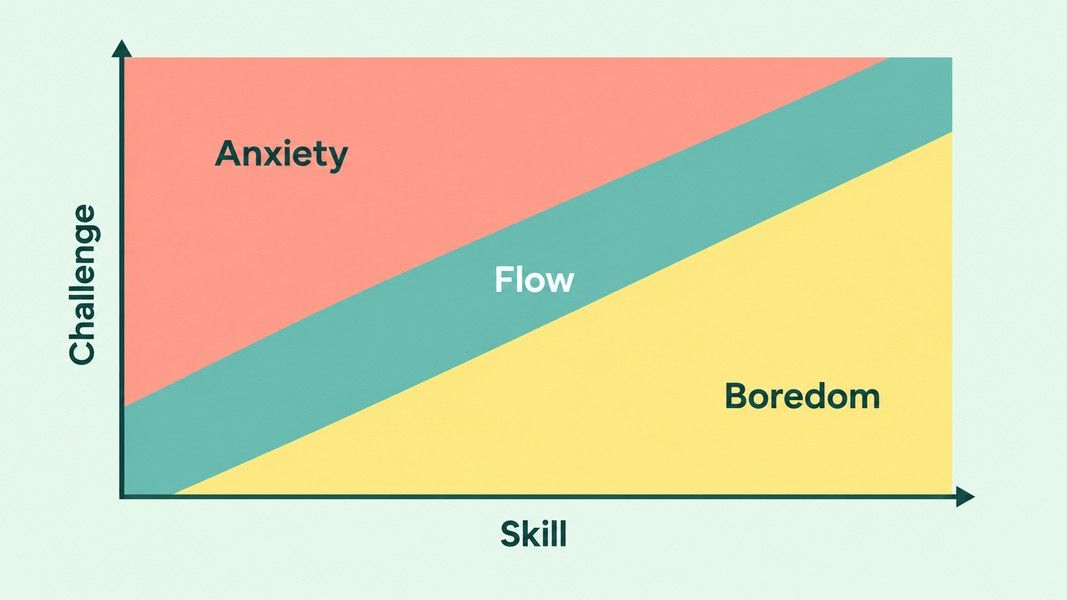
Later versions of the model added a refinement. Flow is most intense when both challenge and skill are high and in balance. Matching an easy task to a beginner's skill can produce a mild version of flow, but the deep, absorbed version shows up when you are near the edge of what you can do.
How researchers measure flow
Flow is hard to study because asking someone whether they are in flow interrupts it. The method that made the research possible was the Experience Sampling Method, introduced by Csikszentmihalyi, Larson and Prescott in 1977. Participants carry a device that prompts them at random moments during the day to report what they are doing and how it feels.
That method still shapes the field. A 2024 study in the Journal of Happiness Studies tested how often to prompt people, comparing ten queries a day with five, and introduced a three-item version of the Flow Short Scale to keep the burden low.
What Happens in the Brain During Flow
The most cited explanation for why flow feels effortless comes from neuroscientist Arne Dietrich.
Transient hypofrontality
In a 2004 paper, Dietrich proposed that flow depends on transient hypofrontality: a temporary quieting of the analytical, self-monitoring functions of the prefrontal cortex.
His argument rests on two systems. The explicit system, tied to the frontal lobe, is flexible and deliberate but slow. The implicit system, supported mainly by the basal ganglia, runs well-practised skills efficiently. In Dietrich's account, flow is the period when a highly practised skill runs on the implicit system without interference from the explicit one. That is why the inner critic goes quiet and the work seems to happen on its own.
It also explains why flow tends to arrive in things you already know how to do. A skill has to be practised enough to run implicitly before the analytical brain can step back.
What the brain studies actually show
The theory is elegant. The evidence is thinner than popular articles suggest. A 2022 systematic review in Cortex gathered 25 experimental studies with 471 participants in total. They pointed to structures linked to attention, executive function and reward, with anterior brain areas playing a central role. The authors concluded that the available evidence is "sparse and inconclusive," because the brain region findings were inconsistent across studies.
Part of the problem is practical. Flow usually happens to motivated people doing a familiar task for long stretches without interruption, and a brain scanner is close to the opposite setting. The same review notes that people differ in how easily they reach flow, and one study it cites estimated the heritability of general flow proneness at 41%.
Flow State and Learning: What the Research Shows
For students, the useful question is whether flow does anything for grades. The research says yes, with caveats.
A 2023 Frontiers meta-analysis on learning flow and academic performance found a pooled correlation of 0.43, with a 95% confidence interval from 0.28 to 0.57. Students who reported more flow while learning tended to perform better. Individual studies varied a lot: one included study of 697 eighth graders found a correlation of only 0.14.
Correlation is not proof that flow causes better grades. Students who already understand the material are more likely to find it absorbing, so the arrow can run both ways. The authors themselves call for more high-quality studies with larger samples.
Why school is a hard place to find flow
A 2015 meta-analytic investigation by Fong, Zaleski and Leach pooled 28 studies on the challenge-skill balance. The link between balance and flow was moderate overall and weaker in work and education contexts. Alongside the balance, clear goals and a sense of control were the most robust contributors to flow.
The 2024 Communications Psychology framework adds a reason. It reports that the challenge-skill balance correlated with flow more than twice as strongly in leisure activities as in work or education, and that feeling pressure to hurry inhibits flow. Studying usually comes with deadlines, assigned tasks and little choice about what to do, which works against the autonomy that flow seems to need.
Why Flow Is Harder to Reach Than It Used to Be
The biggest enemy of flow is the interruption. Flow needs sustained attention to build, and most screen-based work no longer offers it.
Gloria Mark, an attention researcher at the University of California, has tracked attention on screens since 2003. In an interview with UC, she describes how the average time on one screen before switching fell from about two and a half minutes in 2004 to 75 seconds in 2012, and to about 47 seconds in recent years, with a median of 40 seconds.
Her project-level numbers matter more for flow. People spend about 10 and a half minutes on a project before switching, and after an interruption it takes about 25 and a half minutes on average to return to the original project. We are as likely to interrupt ourselves as to be interrupted by a notification.
Every one of those switches resets the build-up that flow needs. If you want the longer version of why switching costs so much, the post on task switching costs covers the research in detail.
How to Enter a Flow State When You Study or Work
You cannot force flow, but you can set up the preconditions the research keeps pointing to. Here is how to enter the flow state more often.
Pick a task at the edge of your skill
Choose work that stretches you a little. If a chapter feels impossible, drop down a level: review the prerequisite concept, or work an easier example first. If the task feels mindless, add a constraint, such as answering practice questions without your notes or explaining the idea in fewer words.
Set one clear goal for the session
"Study biology" is not a goal flow can work with. "Explain how the electron transport chain produces ATP, without looking" is. A clear goal tells you what to do next at every moment, which removes the decision-making that keeps the analytical brain switched on.
Build in immediate feedback
Flow needs to know whether you are on track, quickly. Practice problems with answers, flashcards, or explaining a topic out loud and checking where you got stuck all give that signal. In Primo Notes, the quiz and flashcard tools turn a finished note into questions, and the Feynman mode has you explain the material out loud while the app works the gaps, so each attempt gets a response instead of a vague sense of progress.
Protect a long, unbroken block
Given Mark's numbers, a short session broken up by notifications never gets the chance to build. Put your phone in another room, close every tab you do not need, and plan a block long enough to settle in, ideally an hour or more. If you struggle to sit that long, the guide on how to increase attention span builds up to it in steps.
Stop doing two jobs at once
Taking notes during a lecture splits your attention between listening and writing. Recording the class and turning it into a note afterwards lets you stay with the speaker. Primo Notes takes a recording, a photo of a printed page, a PDF or a YouTube link and returns a structured note and transcript, so capture is handled and your attention can go to the material itself.
Choose when you can
Autonomy shows up again and again as a flow antecedent. Even inside a fixed assignment, you can choose the order of tasks, the method, or where you start. Starting with the part that interests you most is a legitimate way in.
Limits and Myths About Flow
Flow is useful, but it gets oversold.
Flow is not a productivity switch
Flow describes how a task feels, not how much you get done. The brain research is still inconclusive, and the learning research is correlational. Some of the most valuable study work, like effortful recall of material you barely know, often sits closer to the anxiety zone than the flow channel, and it is supposed to feel hard.
Not every task can produce flow
Flow depends on a practised skill, so a brand new subject rarely produces it on day one. Routine admin may never produce it at all. That is not a personal failing. The research shows clear individual differences in how easily people reach flow, which makes comparing yourself with someone who seems to live in flow unhelpful.
More flow is not always better
Absorption is also why time disappears. Losing three hours to the wrong task, or skipping sleep because the work felt good, is a real cost. A timer or a planned stopping point keeps flow working for you.
Conclusion
Flow state is deep, absorbed focus in which a challenging task feels effortless and rewarding in itself. Csikszentmihalyi described it in 1975, and the research since then points to three preconditions you can control: a task that matches or slightly stretches your skill, a clear goal, and immediate feedback.
The brain science behind flow is still unsettled, and the link with better grades is a correlation rather than proof. The interruption research is clearer: attention on screens now shifts every 47 seconds on average, and returning to an interrupted project takes about 25 minutes. Long, protected blocks of work at the right difficulty remain the most reliable way to make flow more likely.