

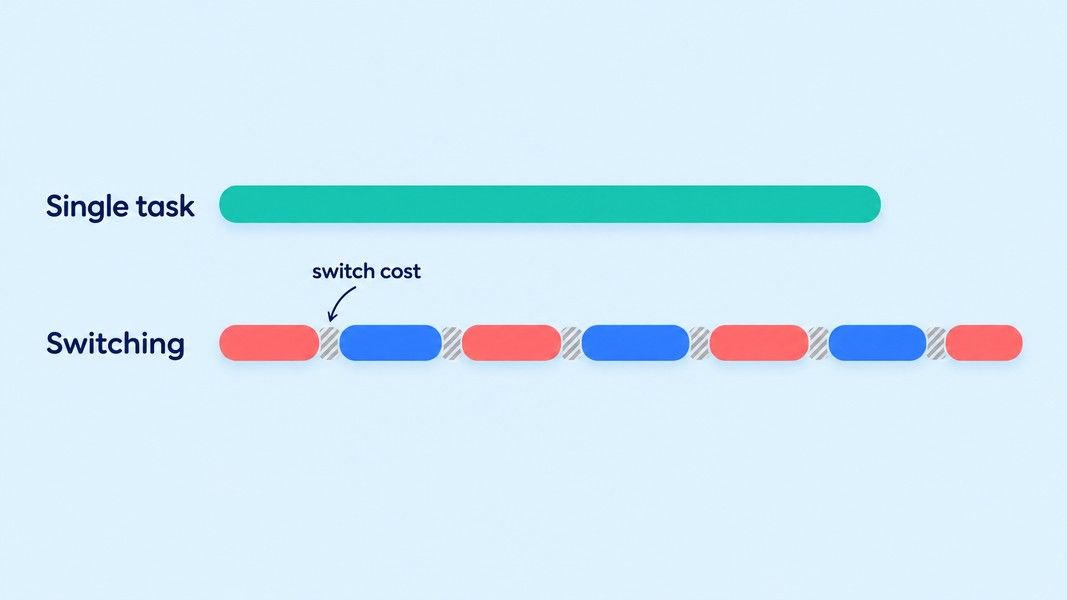
Multitasking, for anything that needs real thought, is not doing two things at once. It is switching between them quickly, and every switch costs you a little time and a little accuracy. Those costs are small enough to miss and large enough to add up over a study session or a working day.
If you feel busy all day and still finish with half your list untouched, the way you split your attention is a likely suspect. The myths below are the ones people actually believe about human multitasking, each checked against what the research found, with a practical alternative for every one.
What Multitasking Really Means
The everyday multitasking definition is doing several things at the same time. Psychologists split that into three different situations: performing two tasks simultaneously, switching from one task to another, and performing several tasks in rapid succession.
That split matters, because only the first one is what people picture when they say they are good at it. The other two are what the brain actually does. According to the American Psychological Association, researchers measure the cost of this mental juggling with task switching experiments: they compare how long people take to finish when they stay on one task with how long they take when they keep changing tasks.
When both tasks need your attention, your brain alternates between them rather than running them in parallel. The question is never whether switching costs something. It is how much, and whether the trade is worth it.
Two tasks can only truly run together when one of them is close to automatic. Walking while listening to a podcast works because walking asks almost nothing of the parts of your mind that process language. Reading a chapter while answering messages does not, because both compete for the same limited attention.
Myth 1: Your Brain Can Do Two Things at Once
This is the root myth, and the oldest one the research has tested. In experiments published in 2001, Joshua Rubinstein, Jeffrey Evans and David Meyer had young adults switch between tasks such as solving math problems and classifying geometric shapes. For every task, people lost time when they switched, and the more complex the tasks became, the more time they lost.
Meyer and his colleagues describe two stages behind every switch. The first is goal shifting: deciding you want to do this now instead of that. The second is rule activation: turning off the rules for the old task and turning on the rules for the new one. Both happen without your awareness, which is exactly why the cost feels invisible.
A single switch can cost only a few tenths of a second. The trouble is repetition. Meyer has said that the brief mental blocks created by shifting between tasks can cost as much as 40 percent of someone's productive time.
What to do instead
Group similar work together. Answer all your messages in one sitting, then close them and read. Each task gets your full set of rules once, instead of reloading them every few minutes.
Myth 2: Practice Makes You a Better Multitasker
If switching is a skill, it seems logical that people who do it constantly would get good at it. A 2009 Stanford study tested exactly that and found the opposite.
Eyal Ophir, Clifford Nass and Anthony Wagner built a media multitasking index and compared heavy media multitaskers with light ones. Their PNAS study found that heavy multitaskers were more easily distracted by irrelevant things around them and by irrelevant memories. The surprising result was that they also performed worse on a test of task switching ability, the very skill they practised most.
The researchers' explanation is that heavy multitaskers struggle to filter out interference from the task they are not doing. Instead of switching cleanly, they carry noise from one task into the next.
Constant multitasking trains you to let distractions in, not to handle them better. Later work has explored this further, and a 2018 review by Melina Uncapher and Anthony Wagner treats media multitasking and its links to attention and memory as an open research field rather than a settled habit to optimise.
What to do instead
Practise the opposite skill. Pick one task, set a short block of time, and keep everything else closed for its length. Your ability to filter out distraction grows from exercising it, not from exposing yourself to more of it.
Myth 3: Some People Are Natural Multitaskers
Almost everyone believes they are one of them. In a 2013 University of Utah study, David Sanbonmatsu and colleagues asked students to rate their own multitasking ability and then measured their real ability with a task that required doing two things at once.
The majority judged themselves above average. Their ratings had no meaningful link to how they actually performed. Worse, the people who multitasked most often, including those who used their phones while driving, tended to be the ones with the most inflated view of their ability, while their actual multitasking ability was lower.
Real supertaskers do exist, but they are rare. Jason Watson and David Strayer tested 200 participants in a driving simulator while they also worked through a demanding memory task. In their supertasker study, the vast majority performed worse when doing both, and only 2.5 percent showed no drop at all.
The odds that you belong to that small group are low, and feeling confident about it is not evidence either way.
What to do instead
Test yourself instead of trusting the feeling. Time a reading session with your phone in another room, then one with notifications on, and compare how much you remember afterwards. The result is usually more persuasive than any study.
Myth 4: Multitasking in Class Only Hurts You
Many students accept that checking social media during a lecture costs them a little, and decide that is their own business. Research on laptop use in classrooms says the cost spreads.
Faria Sana, Tina Weston and Nicholas Cepeda ran a simulated lecture in which some participants multitasked on a laptop. Their classroom laptop study found that those who multitasked scored lower on a comprehension test than those who did not. Participants sitting in direct view of a multitasking peer also scored lower, even though they were not multitasking themselves.
A screen full of unrelated tabs pulls attention from everyone who can see it. That turns a personal choice into a shared one, which is worth knowing before you pick a seat or open a feed.
What to do instead
Keep only the lecture material open, and sit where other screens are out of your line of sight if you can. The hardest kind of multitasking in a lecture is often trying to listen, understand and write everything down at the same time. Recording the lecture in Primo Notes takes the transcription job off your plate, so your attention can stay on following the argument, and the transcript and structured note are there afterwards to review.
Myth 5: Younger Generations Are Wired for Multitasking
The idea of the digital native suggests that people who grew up with phones and laptops process several streams of information better than older people. Paul Kirschner and Pedro De Bruyckere reviewed the evidence in 2017 and concluded that this is a myth on both counts.
Their published review in Teaching and Teacher Education states that information-savvy digital natives do not exist, and that learners cannot multitask: they task switch, and that switching hurts their learning. The authors also warn that teaching designed around these myths hinders learning rather than helping it.
Growing up surrounded by screens gives people familiarity with devices. It does not change the basic limits of attention described in cognitive load theory, where working memory holds only a small amount of new information at a time.
What to do instead
Treat study time the same way at any age: one source of new material at a time. If a topic needs several sources, work through them in sequence and connect them afterwards, rather than keeping them all open and jumping between them.
Myth 6: Switching Fast Gets More Done
Fast switching can feel productive, because you touch many things in a short time. Gloria Mark and her colleagues studied what happens when work is interrupted, in a 2008 paper titled "The cost of interrupted work: more speed and stress".
Their data suggested that people compensate for interruptions by working faster. That sounds like good news until you see the price they reported: more stress, higher frustration, more time pressure and more effort. You may keep up the pace, but you pay for it in a way that wears you down over a week.
Sophie Leroy added another piece in 2009 with the idea of attention residue. When you leave a task before finishing it, part of your attention stays behind on it, and that leftover attention makes it harder to perform well on the next task. Every half finished switch leaves part of your mind on the job you just left.
What to do instead
Finish a sensible chunk before you switch, or write down exactly where you stopped and what comes next. Closing the loop on paper lets you let go of the old task, so less of your attention follows you into the new one.
When Doing Two Things at Once Is Fine
None of this means you must do everything in strict isolation. The APA notes that throwing in a load of laundry while talking to a friend will probably work out all right. The problems start when both tasks are complex, or when the stakes of a slip are high.
A useful rule is to pair one demanding task with one automatic one, never two demanding ones. Folding clothes during a phone call, walking while thinking through a problem, or listening to a recorded lecture while commuting all fit that pattern. Writing an essay during a video call, or reading a dense chapter with a group chat open, do not.
Driving is the clearest case where the stakes change the answer. The APA points out that losing just half a second to task switching can make a life or death difference for a driver on a phone travelling at 30 miles per hour, because the car keeps moving while attention is elsewhere.
How to Replace Multitasking With Focus Blocks
The practical alternative is single tasking in planned blocks. A few habits make it stick:
- Batch shallow work. Messages, email and small admin go into two or three fixed slots a day, not into the gaps between harder tasks.
- Park stray thoughts. When an unrelated idea or task pops up, capture it in a few words and return to what you were doing. A quick voice note in Primo Notes works here, since it turns the thought into a written note without pulling you into a second task.
- End each block with a note. Write one line on where you stopped and what comes next, which limits attention residue when you switch.
- Protect the hardest hour. Put your most demanding work where you are least likely to be interrupted, and treat it as fixed.
If you want a fuller system built on the same idea, the guide to deep work covers longer focus sessions and how to plan a week around them.
Conclusion
Multitasking, for anything that demands thought, is task switching, and each switch costs a little time and accuracy. Meyer's work suggests those costs can reach 40 percent of productive time. Heavy media multitaskers turn out to be worse at switching, not better, and most people who think they are natural multitaskers are not. Genuine supertaskers make up only about 2.5 percent of people tested.
The costs also reach beyond you, as the laptop study showed, and fast switching buys speed at the price of stress. The alternative is simple to describe and takes practice to keep: one demanding task at a time, shallow work batched, stray thoughts parked, and a clear note at the end of every block.