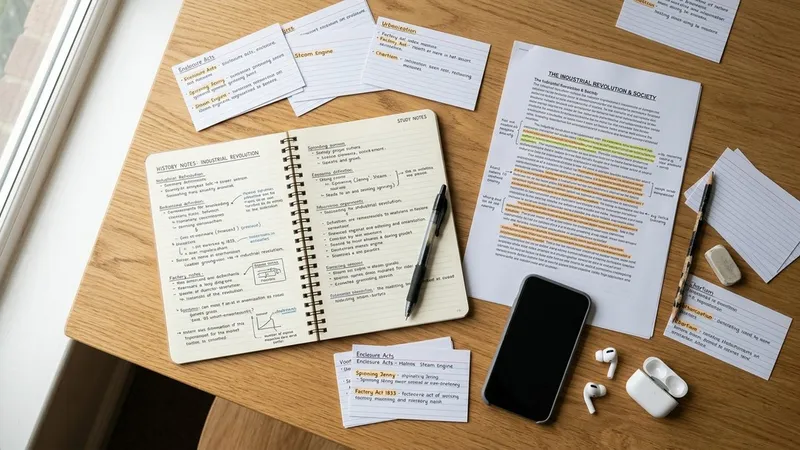

A brain dump is the practice of writing down, or saying out loud, everything that is currently on your mind: tasks, deadlines, worries, half-formed ideas and things you keep meaning to remember. You do it fast and without sorting, so your head stops acting as the storage system. The dump on its own is only half the method. The relief comes when every item on the page has a next step or a place to live.
If you have ever sat down to study and found your mind drifting to an unanswered email, a lab report and a birthday you might forget, you already know the problem a brain dump solves. This guide covers what a brain dump is, the research behind why it works, how to do one in about fifteen minutes, and how to turn the messy result into a plan you will actually follow.
What Is a Brain Dump?
The brain dump meaning is close to literal. You empty your mental inbox onto a page or into a recording without judging, ordering or finishing anything. Nothing is too small to include. "Buy printer ink" sits beside "decide on a thesis topic" and "worried I am behind in chemistry".
Three features separate a brain dump from ordinary note taking. It is exhaustive, because the goal is to catch everything, not the important things. It is unfiltered, because sorting while you write slows you down and makes you skip items. And it is temporary, because the raw list is a staging area that gets processed afterwards, not a document you keep.
People use the term for a few related habits. A morning or evening brain dump journal clears the head at the edge of the day. A study brain dump empties distractions before a focus session. A pre-exam dump, sometimes called blurting, writes out everything you remember about a topic to see what is missing. This guide focuses on the first two, where the aim is a clearer head and a better plan.
Why Your Head Is a Poor To-Do List
Your working memory, the part of the mind that holds what you are thinking about right now, is small. Psychologist Nelson Cowan's review of the evidence puts the central limit at about three to five items for adults. That space has to hold the material you are studying, the problem you are solving and whatever else is competing for attention.
Cowan's paper makes a point that matters for anyone who studies. Working memory can be filled with the concepts being explained in a class, or with distractions such as what you plan to do after class. Every open loop you are trying not to forget takes a slot you needed for the work in front of you.
Why Unfinished Tasks Keep Interrupting
Psychologists have long observed that unfinished goals stay active in the mind, an idea often called the Zeigarnik effect. In a series of studies, E. J. Masicampo and Roy Baumeister found that unfulfilled goals caused intrusive thoughts during an unrelated reading task and hurt performance on an unrelated anagram task.
The finding that makes a brain dump worth doing came next. When participants were allowed to make specific plans for those unfinished goals, the intrusions and the interference disappeared. You do not have to finish a task to stop thinking about it; you have to decide when and how you will do it. The researchers also found the effect depended on how earnest the plans were. The people who later carried out their plans were the ones who stopped experiencing intrusions.
That is why a list of worries on its own helps less than people expect. The writing gets the items out. The planning step is what lets your mind let go of them.
What the Research Says About Writing It Down
Two well-known experiments show what happens when you move thoughts from your head to paper at the right moment.
Before sleep
A team led by Michael Scullin brought 57 young adults into a sleep laboratory and had each write for five minutes before bed. Half wrote a to-do list of tasks for the coming days; the other half wrote about tasks they had already completed. Those in the to-do list group fell asleep significantly faster.
Specificity mattered as well. The more specifically participants wrote their to-do lists, the faster they fell asleep. The researchers suggest that a very specific five-minute list at bedtime may help more than journaling about what you already did. This is a strong argument for an evening brain dump that ends in concrete next steps rather than vague reminders.
Before an exam
Gerardo Ramirez and Sian Beilock ran two laboratory and two randomized classroom experiments on students facing high-stakes tests. A brief writing assignment immediately before the exam, in which students wrote down their thoughts about the upcoming test, significantly improved scores. The benefit was largest for students who were habitually anxious about tests.
That study was about exam worries, not task lists. It still points the same way as the others: putting the contents of a crowded mind somewhere outside it frees up capacity for the task at hand. If test nerves are a regular problem for you, a short dump before the exam is a low-cost habit to add to the strategies in our guide to beating test anxiety.
How to Do a Brain Dump
A useful brain dump takes ten to twenty minutes. Set aside more time the first time you do one, because the backlog is usually larger than you expect.
Step 1: Capture everything
Write or speak without stopping until nothing new comes up. Use prompts if you stall: classes and deadlines, work shifts, people you owe a reply, errands, money, health, things you are worried about, ideas you do not want to lose. Write each item as a short phrase. Do not organise yet, and do not cross anything out.
Speaking is often faster than writing, especially when you are tired. Recording a voice note while you walk can capture a long list in a few minutes. With Primo Notes, you can record that rambling voice memo, or share in a WhatsApp voice note you already sent yourself, and get back a titled, structured note plus a transcript, so the dump is readable before you start sorting it.
Step 2: Sort into a few buckets
Read through the list once and tag each item. Keep the categories few, because a complicated system becomes a new task. Four buckets cover most dumps:
- Do: a concrete action that you are responsible for, such as "email Professor Lee about the extension".
- Schedule: something tied to a date, such as an exam, a shift or an appointment.
- Park: ideas and someday items that deserve a home but no action now.
- Release: worries you cannot act on and items you have decided not to do.
The release bucket matters more than it looks. Some of what fills your head is not a task at all. Naming it and choosing to drop it removes it from the list of things your mind keeps rehearsing.
How to Turn a Brain Dump Into a Plan
Steps 1 and 2 empty your head. Steps 3 and 4 are what make the relief last.
Step 3: Give every action a next step
This is where the research does its work. Rewrite each item in the Do bucket as the next physical action. "Chemistry" becomes "redo practice set 4, problems 1 to 10". "Thesis" becomes "list three possible topics and send them to my supervisor". The plan does not have to cover the whole project; it has to make the next move obvious.
If you recorded your dump, a note's rewrite tool can do the first pass. In Primo Notes you can give rewrite a free instruction such as "turn this into a task list grouped by Do, Schedule, Park and Release, with a next action for each task", then check and correct what comes back. You still make the decisions; the tool removes the retyping.
Step 4: Put each item where you will see it
A plan only works if it lands in the places you already check. Move scheduled items into your calendar with a time, and actions into whatever list you open every day. Park ideas in one notes folder. Then throw the raw dump away or archive it, because keeping it as a second to-do list splits your attention again. For a fuller system that carries tasks from capture through to done, see our action items workflow.
When a Brain Dump Helps Most
A brain dump is not a daily ritual you must keep. It is a tool for specific moments, and it earns its time in a handful of situations:
- At the start of a study block, when distractions keep pulling you off the material.
- At bedtime, when you lie awake running through tomorrow.
- At the start of a week or a term, when deadlines are scattered across syllabi, emails and group chats.
- When you feel stuck or overwhelmed, and cannot decide what to do first.
That last case overlaps with procrastination. A task you keep avoiding is often vague or too large, and turning it into a single next step is one of the most reliable fixes.
A brain dump journal
Some people keep a dedicated brain dump journal and do a short session every evening. That works if each entry ends with the sorting and next step stages. A journal that only collects worries night after night can become rumination rather than relief. Write, sort, plan, close the notebook.
Common Mistakes and Limits
The most common mistake is stopping after the dump. A long unsorted list can feel worse than the scattered thoughts it replaced, because now you can see all of it at once. Budget time for the sorting and planning steps, even if it means a shorter capture.
The second is sorting while you capture. Deciding whether an item matters, and where it goes, interrupts the flow and makes you skip things. Capture first, judge second.
The third is turning the method into a system that needs maintenance. Colour-coded brain dump templates and multi-page layouts look appealing, but a plain page and four buckets do the job. If a template helps you start, keep it simple enough to fill in under ten minutes.
There are also real limits. The studies above measured specific outcomes, such as sleep onset, intrusive thoughts and exam scores, in controlled settings. They do not show that a brain dump fixes chronic anxiety, insomnia or attention difficulties. If worry or overwhelm is persistent and affecting your daily life, a brain dump can sit alongside professional support but is not a replacement for it.
Getting Started Tonight
The simplest way to try it is a five-minute version before bed. Write down every task you are carrying for the next few days, as specifically as you can, and give the most pressing two or three a next action and a time. That small version is close to what Scullin's participants did, and it gives you a quick read on whether the habit suits you.
For a longer session, block twenty minutes at the start of your week. Capture everything, sort into Do, Schedule, Park and Release, write next actions, then move each item into your calendar or task list. Repeat whenever your head starts to feel crowded again.
Conclusion
A brain dump works because your working memory is small and unfinished tasks keep competing for it. Writing everything down gets the items out of your head, and making a specific plan for each one is what allows your mind to stop rehearsing them. Research on plan making, bedtime to-do lists and pre-exam writing all points in the same direction: offloading helps most when it is specific.
Keep the method light. Capture without filtering, sort into a few buckets, give every action a next step, and put each item where you will see it. Then discard the raw list and get back to the work that needed your attention in the first place.