
Working memory is the small mental workspace that holds information while you use it: the phone number you repeat until you dial it, the first half of a sentence while you read the second, the steps of a math problem while you solve it. It holds only a handful of items at once, and it loses them within seconds unless you keep them active.
That limit shapes almost everything about how you learn. When a lecture moves faster than you can process it, or a textbook paragraph collapses the moment you look away, working memory is usually the bottleneck. The good news is that you can design your studying around it once you know how it works.
What Is Working Memory?
Working memory is the system that temporarily holds and manipulates information during thinking tasks. The word "working" matters. It is not a passive storage shelf; it is where reasoning, comprehension, and problem solving actually happen.
A useful picture is a kitchen counter. Long-term memory is the pantry, large and mostly out of sight. Working memory is the counter where you lay out the ingredients you need right now. The counter is small, so you can only prepare a few things at a time, and anything you leave there unattended tends to fall off.
People often use "short-term memory" and "working memory" as synonyms. Researchers usually separate them: short-term memory describes holding information briefly, while working memory describes holding it and doing something with it at the same time. Repeating a list back is short-term memory. Rearranging that list into alphabetical order in your head is working memory.
The Baddeley and Hitch Working Memory Model
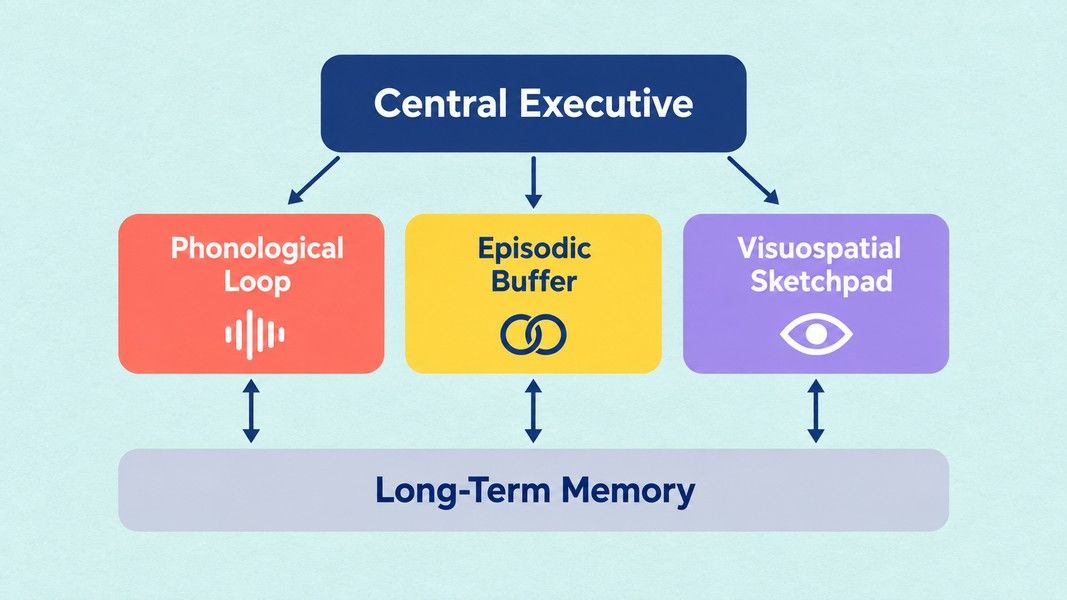
The most influential account of working memory comes from Alan Baddeley and Graham Hitch, who proposed a three-part model in 1974. In 2000, Baddeley added a fourth component, which he described in a paper on the episodic buffer in Trends in Cognitive Sciences. Baddeley's working memory model still frames most research and teaching on the topic.
The Phonological Loop
The phonological loop handles sound and language. It is the inner voice you use to rehearse a word or a number so it does not fade. Research summarized by Nelson Cowan suggests that silent rehearsal can keep about two seconds' worth of speech alive, which is why short words are easier to hold than long ones.
The Visuospatial Sketchpad
The visuospatial sketchpad holds images, shapes, and locations. You use it to picture a route, rotate a shape in your head, or remember where a diagram sat on a slide.
The Central Executive
The central executive is the attention controller. It decides what gets into working memory, switches between tasks, and suppresses distractions. It does not store much itself; it directs the other components.
The Episodic Buffer
The episodic buffer is the newest part of the model. Baddeley described it as a limited capacity store that binds information from the loop, the sketchpad, and long-term memory into a single episode. It explains how you can hold a scene, a sentence with its meaning, or a memory of an event as one integrated unit rather than as separate fragments.
How Much Working Memory Holds, and for How Long
For decades, the popular answer to "how much can you hold in mind?" was seven items, plus or minus two, after George Miller's 1956 paper. Later work revised that figure downward.
In a review titled The Magical Mystery Four, Nelson Cowan argues that the central store of working memory is limited to about 3 to 5 meaningful items in young adults. When rehearsal is blocked, people recall only about 3 chunks, whether those chunks are single words or word pairs they had learned. Young adults can recall only 3 or 4 longer verbal chunks, such as idioms or short sentences.
The key unit is the chunk, not the item. A chunk is any group of information that your long-term memory already treats as one thing. "FBI" is one chunk to most English speakers and three letters to someone who has never heard of it. This is why experts seem to hold far more in mind: their knowledge packs information into bigger chunks, while the number of chunks stays roughly the same.
Capacity also grows with age. In Cowan's array studies, 7-year-olds held about 1.5 items, while older children and adults held about 3.
How Long Information Lasts
Duration is the other limit. In a classic 1959 experiment, Lloyd and Margaret Peterson asked people to remember three-letter strings while counting backward to block rehearsal. They concluded that unrehearsed memories fade within about 18 seconds. Later work by Keppel and Underwood showed that much of that loss came from interference with earlier items rather than time alone, but the practical lesson holds: unrehearsed information in working memory fades within seconds.
Working Memory vs Short-Term and Long-Term Memory
The three terms describe different jobs. Short-term memory is about brief storage. Working memory adds active processing on top of that storage. Long-term memory is the durable store that holds everything you have learned.
The relationship runs both ways. Working memory is the gateway to long-term memory, because new information has to be processed there before it can be stored. Long-term memory then feeds working memory, because the more you already know about a topic, the larger the chunks you can form. This loop is the core idea behind cognitive load theory, which treats working memory as the limiting factor in instructional design.
Why Working Memory Matters for Learning
Working memory is not just a lab curiosity. It predicts how well students learn.
Tracy Packiam Alloway and Ross Alloway followed children over a six-year period and found that working memory is not simply a proxy for IQ. Their study in the Journal of Experimental Child Psychology concluded that working memory at the start of formal education was a more powerful predictor of later academic success than IQ.
Note Taking Competes for the Same Space
Taking notes in a lecture is one of the most demanding things you ask of working memory. You have to hold what the speaker just said, decide what matters, compress it into your own words, and write it down, all while the speaker keeps going. Researchers Annie Piolat, Thierry Olive, and Ronald Kellogg measured the cognitive effort note taking demands in 2005, using dual and triple task methods to track how much executive attention it takes. A 2014 review in Learning and Individual Differences linked stronger working memory abilities to better lecture notes and better test performance.
When the counter is full, something falls off. Usually that is either the explanation you were trying to understand or the note you were trying to write.
Working Memory and ADHD
Working memory difficulties are especially common in ADHD. A 2020 study by Michael Kofler and colleagues found large impairments in central executive working memory in children with ADHD, present in most of the cases they examined. That pattern helps explain why lectures, multistep instructions, and long reading passages feel harder for many students with ADHD, even when the material itself is well within their ability.
Can You Train Working Memory?
Brain training apps often promise that practising memory games will make you smarter or better at school. The research does not support that promise.
A meta-analysis by Monica Melby-Lervåg, Thomas Redick, and Charles Hulme pooled 87 publications with 145 experimental comparisons. They found that training produced short-term improvements on tasks similar to the training itself. For far transfer measures such as reading comprehension, arithmetic, and verbal or nonverbal ability, there was no convincing evidence of reliable improvement when training was compared with a treated control group.
In plain terms, you get better at the game, not at learning. A separate meta-analysis on children's executive functions reached the same conclusion: a clear near-transfer effect, and no convincing far-transfer effect.
That shifts the question. Instead of trying to enlarge the counter, you get better results by putting less on it and by building the long-term knowledge that lets you form bigger chunks.
How to Study Within Your Working Memory Limits
These strategies all follow from the same idea: keep the load on working memory below its limit, and move information into long-term memory or onto an external record as quickly as possible.
Offload What You Do Not Need to Hold
Evan Risko and Sam Gilbert define cognitive offloading as using physical action to reduce the cognitive demands of a task. Writing a list, sketching a diagram, or setting a reminder all count. Every item you offload is one less item competing for the counter.
In a lecture, the biggest offload is the lecture itself. If you record it, you no longer have to choose between listening and writing. Primo Notes turns a recording into a title, a structured note, and a formatted transcript, so you can spend the lecture following the argument and review the details afterward instead of transcribing in real time.
Chunk Before You Memorize
Group related facts before trying to learn them. Turn a list of twelve dates into three periods with four events each. Turn a formula into the two or three ideas it combines. Since capacity is measured in chunks, a smart grouping effectively multiplies what you can hold.
Do One Thing at a Time
The central executive is the part of working memory that switches between tasks, and every switch has a cost. Reading with notifications on, or half listening to a podcast while solving problems, splits a small resource even further. The same logic is why task switching drains focus so quickly.
Build Long-Term Knowledge With Retrieval
The most reliable way to effectively expand working memory for a subject is to know the subject well. Each concept you have stored in long-term memory becomes a chunk you can pull in whole. Retrieval practice, such as answering questions without looking at your notes, is how that knowledge gets built. Primo Notes can generate a quiz and flashcards from any finished note, which gives you retrieval material without the extra step of writing questions yourself.
Use Visual and Verbal Channels Together
Because the phonological loop and the visuospatial sketchpad are partly separate, pairing a diagram with a short explanation spreads the load across both. A mind map of a chapter, for example, lets you see the structure while you talk through the content. Primo Notes includes a mind map tool for this.
Working Memory, in Short
Working memory is the small, fast, fragile workspace where thinking happens. Baddeley's model splits it into a phonological loop, a visuospatial sketchpad, a central executive, and an episodic buffer. Its central store holds about 3 to 5 chunks in young adults, and unrehearsed information fades within seconds.
That limit predicts academic success, makes live note taking hard, and weighs more heavily on students with ADHD. Training games improve performance on the games but do not reliably transfer to reading, math, or reasoning. The strategies that work reduce load instead: offload what you can, chunk what you keep, do one thing at a time, and build long-term knowledge through retrieval so that each chunk carries more.