
Short-term memory is the system that holds a small amount of information in an active, ready state for a few seconds, long enough to use it or pass it on to long-term storage. Without rehearsal, most of what it holds fades in under 30 seconds, and current research puts its capacity at about four meaningful chunks at once.
That is why a phone number slips away while you look for a pen, and why a lecturer's point vanishes the moment the next slide appears. If you have ever wondered why you can follow a class perfectly and still remember little of it an hour later, the answer starts here.
This guide covers what short-term memory is, how long it lasts, how much it holds, how it differs from long-term and working memory, and which habits actually improve it.
What Is Short-Term Memory?
Short-term memory is the temporary store between what your senses pick up and what you keep for good. Information enters it when you pay attention to something, stays while you keep it active, and then either moves into long-term memory or disappears.
The idea is old. Psychologists Richard Atkinson and Richard Shiffrin described memory as a short-term store and a long-term store, with control processes such as rehearsal deciding what gets copied from one to the other. In their account, the short-term store is also where conscious thinking happens, which is why it acts as a kind of working space.
The three stages in one picture
Most textbooks still teach the same simple flow. Sensory memory catches everything for about a second. Attention picks a few items and moves them into short-term memory. Rehearsal and meaningful processing then encode some of them into long-term memory, where they can last for years.
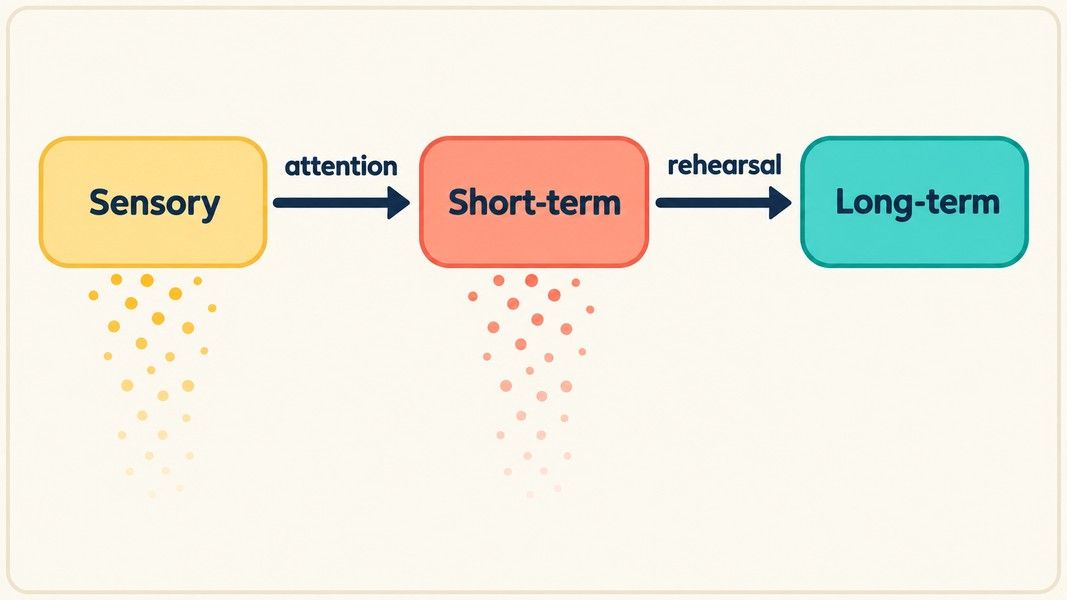
The model is a simplification, and researchers argue about the details. As a practical map for studying, it holds up well: anything you want to remember next week has to survive the short-term stage first.
How Long Does Short-Term Memory Last?
Short-term memory lasts seconds, not minutes. The classic evidence comes from Lloyd and Margaret Peterson's 1959 experiments, in which people saw a short set of letters and then counted backwards to stop them from rehearsing. Recall dropped steeply as the delay grew.
An introductory psychology text summarises the finding plainly: information you do not use or transfer into long-term memory will be forgotten, probably in less than thirty seconds. That window is short enough that a single distraction can wipe it.
Why rehearsal stretches the window
The Petersons blocked rehearsal on purpose. In daily life you rarely do, which is why repeating a code under your breath keeps it alive until you type it. Repetition resets the clock, but it does not by itself make the item permanent. Once you stop repeating, the decay starts again unless the information has been encoded more deeply.
For studying, this matters more than it seems. Listening to a lecture without taking notes or asking yourself questions is a lot like the Petersons' setup: new material keeps arriving, nothing gets rehearsed, and the earlier points drop out.
Short-Term Memory Capacity: Seven Items or Four?
For decades the standard answer was seven. George Miller's 1956 paper on the magical number seven observed that the span of immediate memory is about seven items for many kinds of material.
Miller's deeper point was about chunks rather than the number. He noted that memory span is a fixed number of chunks, so you can hold more information by building bigger chunks. A beginner hearing Morse code treats each dit and dah as a separate chunk; an expert hears whole words.
The newer estimate: about four chunks
In 2001 Nelson Cowan reviewed the evidence again. His paper, published in Behavioral and Brain Sciences and indexed on PubMed, argued that Miller's seven was more a rough estimate and a rhetorical device than a real limit. When people cannot rehearse or group items, the capacity of short-term memory averages about four chunks.
Seven is what you get when rehearsal and prior knowledge quietly help. Four is closer to the raw limit. Both numbers point to the same lesson: you cannot raise the number of slots much, but you can make each slot carry more. That is exactly what chunking in psychology describes, and it is the most reliable way to work with a small store.
Short-Term Memory vs Long-Term Memory
The two systems differ in how long they last and how much they hold. In a 2008 review, Cowan put it this way: short-term memory shows two features that long-term memory does not, decay over time and a limit on the number of chunks.
| Feature | Short-term memory | Long-term memory |
|---|---|---|
| Duration | Seconds, usually under 30 without rehearsal | Minutes to a lifetime |
| Capacity | About four chunks | No chunk limit |
| Main way in | Attention | Rehearsal and meaningful encoding |
| Main way out | Decay and interference | Failure to find a retrieval cue |
Long-term memory is where the material you study has to end up, and it comes in several types, from facts and events to skills. The guide to how long-term memory forms covers that side in detail.
Where working memory fits
Working memory is often used as a synonym for short-term memory, and the overlap is real. Cowan's review notes that researchers define working memory in slightly different ways: as short-term memory applied to a task, as a multi-part system that holds and manipulates information, or as attention managing short-term memory.
A useful working distinction: short-term memory is about holding, working memory is about holding while doing something with it. Remembering a number is short-term memory. Adding it to another number in your head is working memory. Cowan concludes that whether the two are truly separate may be largely a matter of semantics.
Where Short-Term Memory Shows Up When You Study
Short-term memory is the bottleneck in almost every learning situation. A few places where it quietly decides what you keep:
- Lectures. The speaker introduces a term, defines it and moves on. If you are still holding the definition when the example arrives, you have to drop one of them.
- Reading dense text. Long sentences with several new terms overload the store, so you reach the end and have to read the paragraph again.
- Note taking. Writing while listening means holding the last sentence while the next one arrives, which is why handwritten notes often have gaps at the most important points.
- Problem solving. Multi-step math or chemistry problems fail when an intermediate result falls out before you use it.
The common fix is to move information out of your head as early as possible. A written note, a recording or a sketch acts as external short-term memory, so the limited internal store can focus on understanding rather than storage.
Recording instead of racing
This is where a recording helps during class. Primo Notes records a lecture and turns it into a written note with a formatted transcript, so you can listen and think instead of trying to hold and transcribe at the same time. You still have to review the material for it to stick; the recording just stops your short-term memory from being the only copy.
How to Improve Short-Term Memory
You cannot train short-term memory into a much larger store. What you can do is protect it from interference, give it fewer, richer chunks, and help it pass material on to long-term memory. The research below supports each step.
Chunk new information on purpose
Group items into meaningful units before you try to remember them. A 10-digit number becomes three groups. A list of symptoms becomes two or three categories. Cowan's work shows the number of chunks stays roughly constant, so each grouping you create frees room for something else.
Rehearse, then go deeper
Plain repetition keeps an item alive. Linking it to something you already know is what helps it last. Ask yourself why a fact is true, connect it to an example, or explain it out loud in your own words. Each of these turns a fragile short-term trace into a richer one that long-term memory can hold.
Move your phone to another room
In a study published in 2017, Adrian Ward and colleagues randomly assigned people to keep their phone on the desk, in a pocket or bag, or in another room. People whose phones were in the other room scored higher on a test of available working memory capacity than those with their phones on the desk, even though they were not using them. The paper calls this effect brain drain. Keeping the phone out of sight costs nothing and frees attention for the task.
Protect your sleep before a study session
A meta-analysis by Julian Lim and David Dinges pooled 70 articles on short-term sleep deprivation of 24 to 48 hours. Missing a night of sleep significantly reduced performance on both working memory and short-term memory tasks, with working memory effects in the moderate range. An all-nighter before an exam therefore weakens the very system you need to hold each question in mind.
Train attention with short mindfulness practice
Mind wandering pushes useful items out of short-term memory. In a randomised trial, Michael Mrazek and colleagues at UC Santa Barbara found that a 2-week mindfulness course improved working memory capacity and GRE reading-comprehension scores while reducing distracting thoughts. The mindfulness training gains came from less mind wandering among people who were easily distracted at the start.
Test yourself soon after learning
Short-term memory is the doorway, not the destination. Quizzing yourself shortly after a class forces you to pull the material back out, which is what moves it toward long-term storage. Primo Notes can turn a finished note into a quiz or a set of flashcards, which gives you a quick retrieval round while the lecture is still fresh.
What Short-Term Memory Cannot Do
Short-term memory is not a place to store anything you care about. Even with good habits, it holds only a handful of chunks for seconds at a time. Treating it as storage, by trying to remember a long list without writing it down, is the most common reason details go missing.
It also does not decide what you will remember next month. That depends on encoding, spaced review and retrieval, all of which happen after information leaves the short-term store. Improving short-term memory makes learning smoother; it does not replace the work of review.
When forgetting is not normal
Everyday lapses, such as walking into a room and forgetting why, are a normal result of a small, easily interrupted store. Short-term memory problems that are sudden, getting worse or affecting daily life are a different matter and are worth raising with a doctor rather than treating with study techniques.
Key Takeaways
Short-term memory holds a few chunks of information for a few seconds, usually under 30 without rehearsal. Miller's famous seven is closer to four once rehearsal and prior knowledge are taken out, as Cowan's review showed.
It differs from long-term memory in both duration and capacity, and it overlaps heavily with working memory, which adds the job of manipulating what you hold.
You cannot enlarge it much, but you can use it better: chunk information, connect it to what you know, keep your phone out of the room, sleep before important study sessions, practise focusing your attention, and test yourself soon after learning so the material moves on to long-term memory.