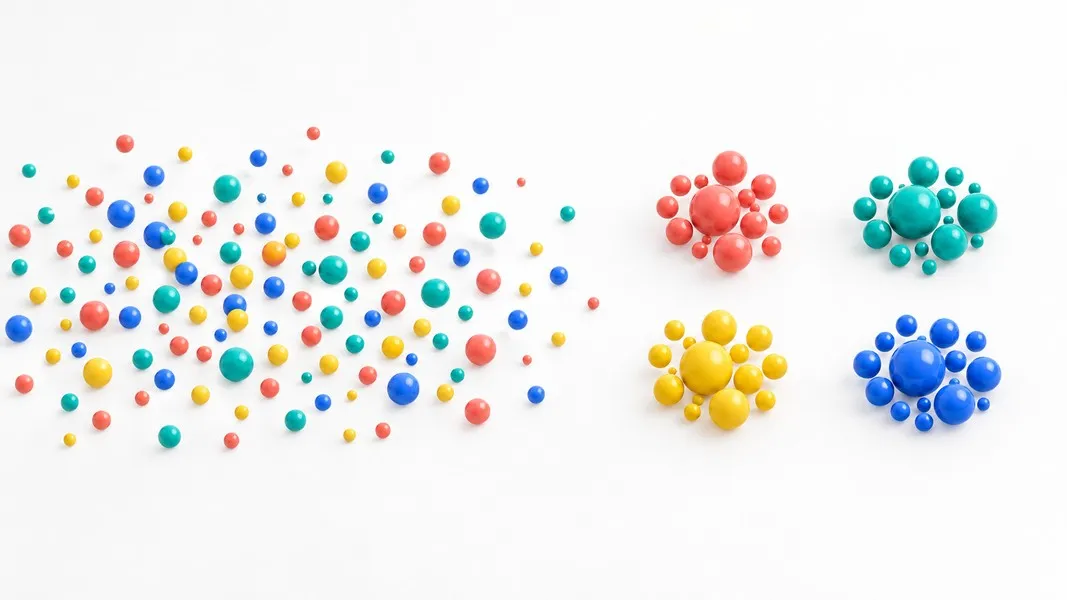
Chunking in psychology is the process of grouping small pieces of information into larger, meaningful units so that memory can hold more of them at once. A phone number remembered as three groups instead of ten separate digits is the textbook case: the information stays the same, but your mind handles fewer items.
If you have ever wondered why some people seem to remember everything while you lose a list of five things on the way to the kitchen, chunking is a large part of the answer. It explains how experts see patterns that beginners miss, why your short-term memory feels so small, and how you can study in a way that works with that limit instead of against it.
This guide covers the definition, how chunking works in working memory, everyday and research examples, its real limits, and practical ways to use it when you study.
What Is Chunking in Psychology?
A chunk is a unit of information that your mind treats as a single item. Psychologists describe it as a collection of elements that are strongly linked to each other and only weakly linked to elements in other chunks. The letters C, A and T are three items to a child learning to read and one item, the word "cat", to you.
The idea comes from George Miller's 1956 paper on the magical number seven, one of the best-known articles in psychology. Miller argued that memory span is limited by the number of chunks it holds, not by the amount of information inside them. In his words, since the span is a fixed number of chunks, you can increase the information it contains simply by building larger and larger chunks.
His favourite illustration was a beginner learning radiotelegraphic code. At first, each dit and dah is a separate chunk. With practice, the sounds group into letters, the letters into words, and the operator ends up holding whole phrases with the same mental capacity that once held a few beeps.
For an AP Psychology definition, the short version works well: chunking is organising items into familiar, manageable units to get around the limited capacity of short-term memory.
How Chunking Works in Working Memory
Your working memory is the small mental workspace where you hold and manipulate information right now. It is famously limited, and the limits of working memory shape almost everything about how you learn.
Miller put the limit at about seven items, plus or minus two. Later research revised that number downward. In a major 2001 review, psychologist Nelson Cowan argued that Miller's seven was more a rough estimate and a rhetorical device than a real capacity limit, and that when people cannot group items into larger units, the true limit is closer to three to five chunks. In later work, Cowan noted that young adults can recall only three or four longer verbal chunks, such as idioms or short sentences.
So if the workspace holds only around four things, how do people ever remember a paragraph, a recipe or a proof? Chunking is the answer. Each chunk takes up one slot, no matter how much it contains, as long as your long-term memory already knows what the chunk means.
Why Chunking Frees Up Working Memory
A 2019 study by Mirko Thalmann, Alessandra Souza and Klaus Oberauer tested this directly. Across four experiments, chunking improved recall not only of the chunked material but also of other, unchunked information held at the same time. That means chunking did more than help the grouped items; it lowered the overall load.
Their explanation is that a chunk works by retrieval. Instead of holding every element, working memory holds a compact pointer to a representation already stored in long-term memory. The details live elsewhere, and the workspace only keeps the label.
Chunking Psychology Examples From Everyday Life
You already chunk constantly, mostly without noticing. A few of the clearest examples show how ordinary it is.
Phone numbers are the clearest case. Cowan points out that telephone numbers around the world typically contain 6 to 10 digits, yet they are almost always divided into groups of 2 to 4 digits. That formatting is chunking built into a public system.
Acronyms and familiar strings work the same way. Researchers Fabien Mathy and Jacob Feldman give the example of the letters USA or a repeating pattern like BBB inside a longer sequence. Each can be stored as one chunk rather than three separate letters, because the pattern is already familiar.
Reading is chunking too. A fluent reader does not process words letter by letter. Familiar words, and often familiar phrases, arrive as single units, which is why you can read a sentence faster than you could memorise a random string of the same letters.
The common thread across all of these chunking psychology examples is meaning. A group only works as a chunk when it connects to something you already know.
What Chess Masters Reveal About Chunks
The most famous chunking research comes from chess. In 1973, William Chase and Herbert Simon showed chess positions to players of different skill levels and asked them to reconstruct the boards. Masters recalled game positions far better than weaker players.
The explanation was not a better memory in general. Chase and Simon wrote that masters appear to be constrained by the same severe short-term memory limits as everyone else. The difference was that experts had stored thousands of chunks, patterned clusters of pieces, in long-term memory. A master sees a familiar castled king position as one unit; a beginner sees six separate pieces.
Fernand Gobet and Herbert Simon revisited the idea in a 1998 study. Their data closely matched the original findings, confirmed that the two-second pause used to mark chunk boundaries was robust, and concluded that chunks have psychological reality. Masters in the newer study used substantially larger chunks, which led the authors to extend the theory with templates: large retrieval structures in long-term memory that hold whole families of positions.
How One Runner Remembered 79 Digits
An even more striking case is a participant known as SF. In a study by Anders Ericsson, William Chase and Steve Faloon, SF practised the digit span task in the lab for more than 230 hours and raised his span from 7 to 79 digits.
SF was a runner of average intelligence. He did it by recoding digit sequences as running times, so a string of numbers became a single meaningful chunk like a race result. His working memory had not grown; his chunks had.
Why Chunking Matters for Learning
The chess and SF studies point to the same lesson. Raw memory capacity is roughly fixed, but the size of each chunk is not. What grows with learning is the library of chunks in long-term memory, and that library lets the same small workspace handle far more complex material.
This changes how you should think about being "good at" a subject. An experienced chemistry student does not hold more items in mind than a beginner. They hold "SN2 reaction" as one unit where the beginner holds a dozen loose facts about nucleophiles, carbon centres and leaving groups.
It also explains why new material feels exhausting. When nothing is chunked yet, every detail competes for one of your three or four slots. This is the core idea behind cognitive load theory, and it is why the first week of any course feels harder than the fifth.
The Limits of Chunking
Chunking is powerful, but it is not a trick that works on anything. The research shows three clear limits.
First, chunks depend on prior knowledge. Thalmann and colleagues concluded that the benefit comes from retrieving a stored representation from long-term memory. If there is nothing stored, there is nothing to retrieve, and grouping random items does far less.
Second, chunks can interfere with each other. In the same study, the benefit held regardless of chunk size only when each chunk was built from unique elements. When several chunks shared overlapping elements, that advantage disappeared. Groups that are too similar to each other blur together.
Third, the capacity limit itself does not move. SF's 79 digits came from a system tuned to digits and running times. Chunking lets you pack more into each slot; it does not give you more slots. As Cowan observed, the hard part of studying capacity is identifying which chunks a person actually uses.
How to Use Chunking When You Study
Knowing the theory is useful only if it changes how you work. These techniques apply chunking directly to studying.
Group by meaning, not by length
Splitting a chapter into equal pages is not chunking. Group material by idea: the causes of an event together, the steps of a process together, the symptoms of a condition together. A meaningful group retrieves as one unit; an arbitrary one does not.
Give every chunk a name
A chunk you can label is a chunk you can retrieve. Write a short heading for each group of ideas in your notes, then practise recalling the full content from the heading alone. The heading becomes the pointer that working memory holds.
Build small chunks into bigger ones
Experts did not start with large chunks. Learn the smallest units until they feel automatic, then combine them. In a language, that means words, then phrases, then sentence patterns. In maths, it means single operations, then common sequences of operations.
Keep similar chunks distinct
Because overlapping chunks interfere, study confusable topics side by side and name what separates them. If two drugs, two theories or two historical periods keep merging in your head, the fix is to make each chunk's distinctive feature explicit.
Turning Lectures Into Chunks You Can Study
A full lecture recording is the opposite of chunked: an hour of continuous detail. Primo Notes turns a recording, a PDF or a YouTube link into a titled, structured note, which gives you groups to work with instead of a wall of text. From there, a few tools map onto chunking well:
- The mind map tool lays a note out as branches, so you can see which ideas belong together.
- Flashcards break each group into small cards you can recall one at a time.
- A quiz checks whether you can retrieve each chunk without looking at the note.
Primo Notes also offers a Feynman mode, where you explain the material out loud and the app works the gaps. Explaining a topic in your own words is a strong test of whether the pieces have truly fused into a chunk or are still loose facts.
Key Takeaways on Chunking
Chunking is how a mind with a very small workspace manages complex information. Short-term memory holds roughly three to five chunks, not Miller's original seven, but each chunk can carry far more than a single item when long-term memory already knows what it means.
The research is consistent. Chess masters face the same memory limits as beginners and win on stored patterns. SF reached 79 digits by recoding numbers into running times, not by expanding his memory. Chunking lowers the load on working memory because a compact representation from long-term memory stands in for the details.
For studying, the practical rules follow directly: group by meaning, name each group, build small chunks into larger ones, keep similar chunks distinct, and test recall one chunk at a time. Over weeks of practice, that is what turns a subject from a pile of facts into something you can think with.