

Imposter syndrome is the persistent feeling that you are not as capable as other people think, and that your success came from luck, timing, or effort rather than real ability. People who have it fear being "found out" even when the evidence of their competence is in front of them.
If you have ever finished an exam, a project, or a presentation and felt relief instead of pride, you know the feeling. This guide covers what the research says about imposter syndrome, the signs to watch for, where it comes from, and the methods that have actually been tested for overcoming it.
What Is Imposter Syndrome?
Psychologists Pauline Rose Clance and Suzanne Imes first described the pattern in 1978, after working with high-achieving women who believed their intelligence had been overestimated. They called it the impostor phenomenon, which is why research papers spell it with an "o" while most people search for "imposter."
Imposter syndrome is not a medical diagnosis. You will not find it in diagnostic manuals, and researchers still disagree on whether to call it a syndrome, a phenomenon, an experience, or a set of thoughts. MIT researcher Basima Tewfik avoids the word "syndrome" entirely, because it implies a disorder, and uses "workplace impostor thoughts" instead: the belief that others overestimate your competence.
That definition is useful because it is narrow. Imposter syndrome is not general low confidence. It is a gap between how others see you and how you see yourself, where you trust your own harsh view over every piece of outside evidence.
How Common Imposter Syndrome Is
The short answer: very common, though the exact number depends on how you measure it.
A systematic review in the Journal of General Internal Medicine pooled 62 studies covering 14,161 participants. It found prevalence rates ranging from 9% to 82%, a spread the Bravata review attributed mostly to the different screening tools and cutoff scores each study used. The same review found imposter feelings among both men and women and across age groups, from adolescents to late-career professionals.
Students show up often in this research. A 2026 meta-analysis in PLOS One of 26 studies and 9,110 medical students found a pooled prevalence of 54.2% using the Clance Impostor Phenomenon Scale. A 2025 scoping review in BMJ Open reported rates between 30.6% and 75.9% among medical undergraduates.
The numbers vary, but the pattern holds across studies: feeling like an imposter is close to normal in demanding academic settings, not a rare personal flaw.
Signs of Imposter Syndrome
Imposter syndrome rarely announces itself. It shows up as habits and thought patterns that feel like conscientiousness from the inside. The most common signs include:
- Discounting praise. Positive feedback feels like a mistake or politeness rather than information.
- Crediting luck or effort. A good grade "only happened" because the exam was easy or because you studied harder than anyone else.
- Fear of being exposed. You expect someone to notice, any day now, that you do not belong.
- Overpreparing. You prepare far more than the task needs because anything less feels risky.
- Procrastinating, then cramming. You delay starting, then rush at the last minute.
- Avoiding help. Asking a question feels like admitting you are a fraud.
- Constant comparison. Everyone else seems to understand things faster and more easily.
None of these alone means you have imposter syndrome. The pattern matters: when several appear together and persist after clear success, the feeling is doing the reasoning, not the evidence.
The Impostor Cycle
The most useful idea in the research is the impostor cycle, which Clance described in 1985. According to the StatPearls summary from the US National Library of Medicine, the cycle is one of the most characteristic features of imposter syndrome.
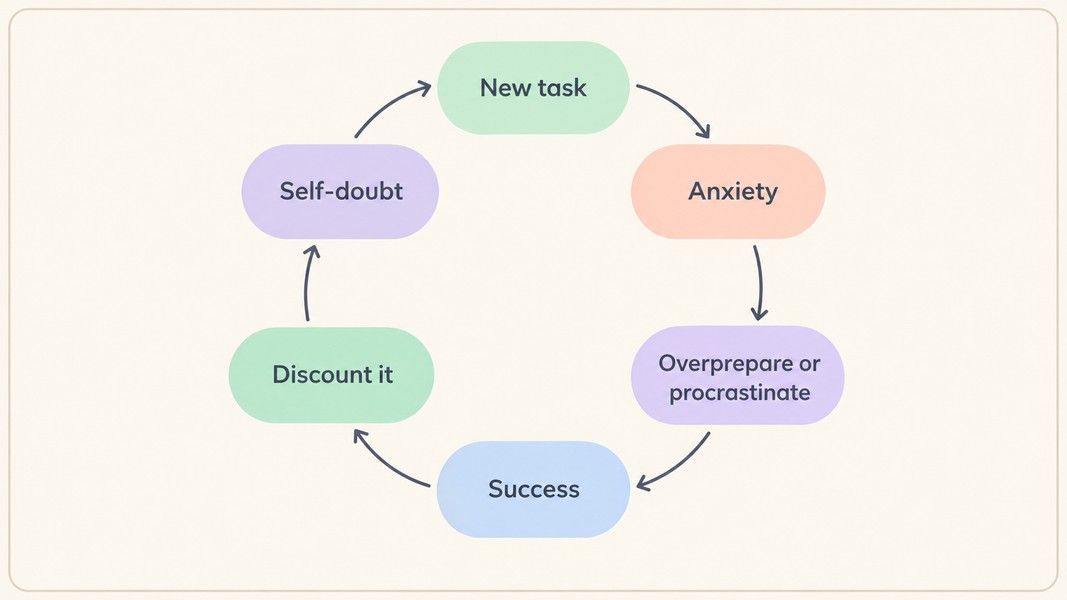
It runs like this. A new task arrives, such as an exam, a paper, or a presentation. Anxiety and self-doubt follow. You respond in one of two ways: you overprepare, or you procrastinate and then prepare in a frenzy.
Then you succeed. There is a short burst of relief, but it fades fast, because the way you succeeded seems to prove the fear right. If you overprepared, the success "only" came from extra work. If you procrastinated, it "only" came from luck.
Why the Cycle Keeps Repeating
Researchers Sakulku and Alexander point out that people caught in the cycle hold a fixed belief that success through hard work does not reflect real ability. Each success is filed under effort or luck, so it never counts as evidence of competence. The next task triggers the same anxiety, and the loop starts again.
This is why more success does not cure imposter syndrome on its own. The problem is not a lack of achievements, it is the way those achievements get explained.
What Causes Imposter Syndrome
There is no single cause, but the research points to a few consistent triggers.
Transitions and New Environments
The BMJ Open review found imposter feelings among medical undergraduates were linked to transition periods, learning breaks, and poor academic performance. Starting university, moving into a harder program, or starting a first job all put you among new peers, with new standards and no track record yet.
Early Messages About Ability
Sakulku and Alexander describe family environments that place a high value on intellectual ability, or that suggest success should require little effort. If you learned early that "smart people don't have to try," every hour of studying can feel like proof you are not smart.
Being in the Minority
The Bravata review found imposter syndrome was particularly common among ethnic minority groups, and one study in it linked imposter feelings to minority status stress. Being one of few people like you in a room makes the question "do I belong here?" louder.
Is It Always in Your Head?
Not always. In a widely shared Harvard Business Review article, Ruchika Tulshyan and Jodi-Ann Burey argue that labelling women's doubts as imposter syndrome can hide the real problem, writing that feeling like an outsider is often systemic bias and exclusion rather than an illusion. If a setting really does treat you as an outsider, your feeling is partly a correct reading of the room, and the fix is partly outside you.
Is Imposter Syndrome Always Bad?
Surprisingly, not entirely. Tewfik tested the question across four studies with 3,603 participants, using surveys, video data, and pre-registered experiments. As MIT News reported, people with more frequent impostor thoughts were rated as more interpersonally effective by others, because they became more other-focused, for example asking more questions in conversation.
They were not rated as less competent either. In one study of physicians in training, impostor thoughts did not hurt diagnostic accuracy.
Tewfik is clear that this is not a reason to cultivate the feeling. Her work also found that impostor thoughts lower self-esteem, and she notes there are better ways to become interpersonally effective. The takeaway is narrower: the feeling does not mean you are failing, and it may be pushing you toward habits that serve you well.
How to Overcome Imposter Syndrome
Research on treatment is younger than research on prevalence. The 2019 Bravata review found no published studies that evaluated treatments at all. A 2024 scoping review in Frontiers in Psychology found that has started to change, with two broad approaches emerging: counseling, such as coaching and support groups, and training, such as workshops. The methods below map onto those findings and onto the causes above.
Name It and Talk About It
Imposter syndrome feeds on secrecy, because each person assumes everyone else is genuinely confident. Talking breaks that assumption.
In one program in the Frontiers review, internal medicine residents joined a 30 to 45 minute small-group discussion about imposter syndrome. Afterward, 96% felt comfortable recognizing it in themselves, and 81% saw the discussion as an effective way to support wellness. Peer reflection groups for medical students in the same review fostered connection and a sense of belonging.
You do not need a formal group. Telling one classmate or colleague "I feel like I got in by accident" often gets you a "me too," and that answer is evidence the cycle cannot easily explain away.
Framing helps too. A 90-minute workshop for health science students in the same review paired impostor awareness with growth mindset ideas. The students' impostor scores did not change, but they reported handling the feelings better and making steady progress on their challenges.
Keep an Evidence File
Clance's own therapy techniques included a diary of compliments and a diary of attributions, where you write down what went well and what actually caused it. A later set of recommendations for physicians included tracking successes to build internal validation.
The point is to fight selective memory. Imposter syndrome remembers every mistake and forgets every win. A written record does not.
Keep it simple and fast, or you will not keep it at all. Some people record a short voice note after a good seminar, a strong exam, or useful feedback from a supervisor. With Primo Notes, a spoken note comes back as a written note with a title and a transcript, so the evidence is there the next time doubt shows up.
Break the Overprepare or Procrastinate Loop
Since the cycle runs on two extreme responses, the fix is a planned middle. Decide in advance how much preparation a task deserves, then stop when you reach it.
The Frontiers review describes an online training module for first-year dental students that taught six coping strategies. Two of the most used were cutting back on non-essential tasks and using a schedule to avoid procrastination. After the semester, the share of students with strong impostor feelings dropped from 13.6% to 4.9%.
If procrastination is your side of the cycle, it helps to look at what drives it, which is covered in depth in this guide to stopping procrastination.
Test What You Know, Not What You Feel
Imposter syndrome is a judgment based on feeling. You can replace part of it with a judgment based on performance.
Explain a topic out loud without notes, then check what you missed. Answer practice questions before deciding you "don't really understand" something. Primo Notes has a Feynman mode for exactly this: a guided spoken session where you explain the material from a note out loud and the app works the gaps. It can also turn the same note into a quiz or flashcards.
The result is concrete. You either know it, which is evidence against the imposter story, or you find a specific gap, which is a task rather than a verdict on your ability.
Get Coaching, Mentoring, or CBT
Structured support has the strongest evidence so far. In a randomized controlled trial with 1,017 women physician trainees, a four-month online group-coaching program reduced imposter syndrome, burnout, and moral injury compared with a waiting-list control group, and improved self-compassion. A smaller trial of the same program with 101 resident physicians found similar results.
One study compared two approaches directly. Individual coaching reduced impostor scores more lastingly, while group training was better for learning about the phenomenon.
Cognitive behavioral therapy shows up throughout the clinical literature. Therapists use self-observation, cognitive restructuring, and behavioral exercises to break the cycle, including the attribution diary described above. Many universities offer free counseling that can apply these methods.
When to Get More Support
Imposter syndrome is often comorbid with depression and anxiety, according to the Bravata review, and the Frontiers review links it to stress, burnout, and emotional exhaustion.
If the feelings are affecting your sleep, your mood most days, or your ability to start work at all, treat that as a signal to talk to a counselor or doctor rather than a challenge to push through alone. Self-help methods work best on top of support, not in place of it.
Conclusion
Imposter syndrome is the belief that you have fooled others into overestimating you, and it is far more common than it feels, with studies of students often finding it in a third to three quarters of participants. It is not a diagnosis and not proof that you do not belong.
It runs on a cycle: anxiety, overpreparing or procrastinating, success, then explaining that success away. Transitions, early messages about ability, and environments where you are in the minority make it louder, and sometimes the outsider feeling reflects a real problem in the setting.
What helps is talking about it, keeping a written record of real evidence, planning preparation so it stops swinging between extremes, and testing your knowledge instead of trusting the feeling. Where it weighs heavily, coaching and therapy have the strongest evidence behind them.