
Note taking methods are structured ways of capturing information while you listen or read, and the main ones are Cornell, outline, mapping, charting, sentence and boxing. Each shapes the page differently, and each changes how much you write, how fast you write it, and how usable the page is two weeks later when you sit down to revise.
The honest answer to "which method is best" is that the format matters less than most study guides claim. What moves exam results is how complete your notes are and whether you go back to them. Pick a method that helps you get more of the lecture onto the page, then build a review habit around it. This guide covers the six methods in detail, the evidence behind each, and how to choose based on the class you are sitting in rather than on personality quizzes.
What Note Taking Methods Actually Do
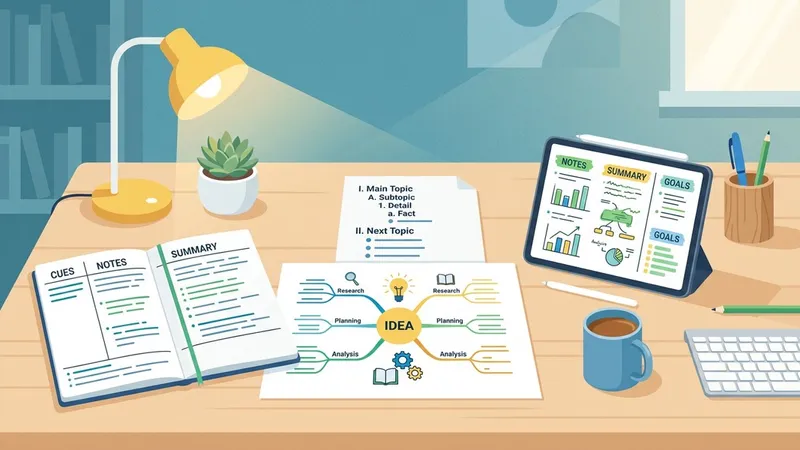
A note taking method is a page layout plus a set of rules about what goes where. Cornell splits the page into cues, notes and a summary. Outline nests ideas by indentation. Mapping draws relationships as branches. Charting builds a grid of categories before the lecture starts.
The layout is not decoration. It decides what you can physically record in the time you have, and it decides how quickly you can find one fact later. A method that forces you to categorise while you listen will slow your writing down and sharpen your understanding. A method that lets you write freely will capture more and organise less.
That trade-off is the whole subject. Everything below is a different answer to it.
The Two Jobs Every Method Has To Do
Research on note taking has separated two functions since the 1980s. The first is encoding: the act of writing itself changes how you process the material, because you have to decide what matters and restate it. The second is external storage: the page becomes a record you can study from later.
Kenneth Kiewra's work established that both matter and that they are not the same thing. Taking notes helps even if you never read them again, and reading them again helps on top of that. The two effects stack.
This distinction explains why method comparisons so often disagree. A method that is great for encoding, like mapping, can produce a page that is hard to revise from. A method that produces a clean study document, like charting, can be too rigid to keep up with a fast talker. Judge any method on both jobs, not one.
Cornell Method
The Cornell system was developed in the 1940s by Walter Pauk at Cornell University, and it is still the most widely taught format in the world. You divide the page into three areas. A narrow left column holds cues, questions and key terms. A wide right column holds the notes you take during class. A band across the bottom holds a summary you write afterwards.
The structure works because it builds review into the format. The cue column turns your own page into a self-test: cover the right side, read the cue, try to recall the detail. The summary band forces you to compress the lecture into a few sentences while it is still fresh.
A recent classroom study on note taking methods and lasting learning describes the Cornell system as organising information specifically to promote review and summarisation, and links its benefits to exam performance and retention. The cost is speed. Splitting attention across three zones while a lecturer moves at full pace is difficult in dense technical classes, which is why many students write in the notes column during class and fill the cue column afterwards. If you want the layout ready to go, our Cornell note templates cover the standard page divisions.
Outline Method
The outline method nests information by indentation. Main topics sit at the left margin, supporting points indent one level, examples and detail indent again. Numbering or lettering is optional, and most students drop it.
It suits any lecture that is already hierarchical, which covers most of them. A lecturer who works through three causes of an event, each with two consequences, is dictating an outline whether they mean to or not. Your job is to hear the level changes and match them on the page.
The method is fast, because you are writing phrases rather than sentences and the structure comes from spacing rather than from labels. It also reviews well: the indentation itself carries meaning, so skimming the left margin gives you the skeleton of the lecture in seconds.
Its weakness shows up in classes that jump around. A lecturer who returns to an earlier point after two tangents will break your hierarchy, and you will either leave the page messy or waste time redrawing it. Our outline method guide covers the mechanics in more detail.
Mapping Method
Mapping puts the central topic in the middle of the page and branches outward. Related ideas connect by lines, and the visual arrangement carries the relationships that an outline would express through indentation.
The strength is relational understanding. Subjects built on connected systems, such as biology, history or anything with feedback loops, map far better than they outline. Drawing the connection forces you to decide what connects to what, which is real cognitive work rather than transcription.
The weakness is capacity. A single page holds a limited number of branches before it becomes unreadable, and you cannot easily insert a new branch into a crowded area. Mapping also struggles with sequential material where the order of steps is the point.
Most students who map well do it in two passes. They capture in a linear format during the lecture, then rebuild the material as a map that evening. The rebuild is where the learning happens, and it doubles as review.
Charting Method
Charting is a grid. You decide the columns before the class starts, then fill rows as the lecture supplies them. A comparative politics lecture might use country, system, head of state and term length. A pharmacology lecture might use drug, class, mechanism and side effects.
When the material is genuinely parallel, nothing beats it. The grid makes gaps visible, because an empty cell is an obvious question to ask. It also makes comparison across rows immediate, which is exactly what comparison questions on exams demand.
There is direct evidence for this format. In a study published in the Journal of Educational Psychology, Kiewra and colleagues gave undergraduates three types of notes to review: full text, a linear outline, or a matrix. Matrix and outline notes both produced higher recall than full text, and matrix notes produced the greatest transfer, meaning students were better at applying what they had learned to new problems.
Charting fails when the lecture is not parallel. If you build four columns and the lecturer spends forty minutes on one concept, the grid becomes a cage.
Sentence Method
The sentence method is the simplest format: every new idea goes on its own line as a complete sentence. There is no hierarchy, no grid and no decision to make while you write.
That is both the appeal and the problem. Because you are not classifying anything, you can keep up with almost any speaker, which makes it the fallback when a lecture is fast, unstructured or unfamiliar. The page you end up with is a transcript in rough form.
Reviewing from it is hard work. Nothing on the page tells you which sentence was a main point and which was an aside, so you have to reconstruct the structure later. Used deliberately, that reconstruction is a strong study session. Used by default, it becomes a page nobody opens again.
If you use the sentence method, commit to a second pass within a day. Number the main points, group the supporting lines under them, and cut the noise while you still remember what mattered.
Boxing Method
Boxing groups related notes inside drawn boxes, one box per subtopic. It became popular with tablet note takers, because moving and resizing a box is trivial on a screen and awkward on paper.
The boxes do two useful things. They give each subtopic a visual boundary, so your eye finds the section you want without reading. They also let you keep working on a subtopic after the lecture has moved on, since you can return to an earlier box and add to it rather than appending at the bottom of the page.
It fits seminar-style classes where discussion circles back repeatedly, and lectures with clear independent segments. It fits continuous argumentative material poorly, because drawing a boundary implies a separation that the material does not have.
Handwriting Versus Typing
This is the argument everyone has heard, and the evidence has moved since the headline was written. The original 2014 study in Psychological Science by Mueller and Oppenheimer found that students who typed performed worse on conceptual questions, and attributed it to verbatim transcription. Typing is fast enough to copy a lecturer word for word, and copying skips the processing that makes notes useful.
Five years later, Morehead, Dunlosky and Rawson ran a direct replication with additional groups. Performance did not consistently differ between longhand, laptop and eWriter conditions, and differences shrank further once students had studied their notes. Their meta-analysis of the direct replications found small effects favouring longhand that were not statistically significant.
The mechanism survived even though the headline did not. Verbatim copying is the problem, not the keyboard. A student who types in their own compressed phrasing is doing the same cognitive work as one writing longhand. A student who handwrites a transcript is not.
What the Evidence Says About Choosing a Method
Here is the finding that should reset expectations. A systematic review and meta-analysis of note taking method and academic performance found a mean effect size of g = -0.008, with a confidence interval spanning zero. Across the pooled studies, the method students used did not predict how well they did.
That result is easy to misread. It does not mean note taking is pointless, and it does not mean the formats are interchangeable for you personally. It means the format alone, averaged across thousands of students and many contexts, is not the lever.
The variables that do move results are completeness and review. Both are things a method can support or undermine, which is the real reason to care about format. Choose the one that gets more of the lecture onto your page and gets you back to that page later.
Completeness Is the Variable That Moves Results
Student notes are far less complete than students assume. Kiewra's summary of the research reports that students capture only 20 to 40 percent of a lecture's main ideas, and individual studies land across a wide band, with some samples recording as little as 20 percent of critical ideas.
Missing 60 percent of the main ideas is a bigger problem than choosing the wrong layout. Everything you do later, every flashcard, every practice question, every revision session, runs on the page you produced, and none of it can recover an idea that never got written down.
Structure helps here in a measurable way. Kiewra's review reports that students given skeletal notes, meaning a partial outline handed out before class, recorded 56 percent of lecture ideas, against 38 percent for students taking conventional notes. The pre-built structure told them what to listen for.
You can build your own skeleton. Read the slides or the assigned chapter beforehand and write the headings on your page in advance. You arrive with a frame instead of a blank sheet.
Review Is Where Notes Pay Off
The second half of the equation is what happens after class. Note taking during a lecture is sometimes no more effective than not taking notes at all when the notes are never reviewed, and the storage benefit only exists if you return to the page.
There is an interesting wrinkle in Kiewra's 1984 data: students who took their own notes and reviewed their own notes scored 93 percent on an immediate recognition test, while students who took notes but then reviewed the instructor's notes scored 71 percent. Your own phrasing is a better retrieval cue than someone else's, even when theirs is more complete.
The practical rule that follows is simple. Review your own notes, and do it as retrieval rather than rereading. Cover the page, answer the cue, check. The Cornell layout builds this in by design, and any method can be adapted to it by adding questions in the margin. Pair that with spaced review, and use active recall rather than rereading when you do.
How to Pick a Method For Your Class
Match the method to the shape of the material, not to your self-image as a visual or verbal learner. Three questions settle most cases.
- Is the material parallel? If the lecture covers several things that share the same attributes, chart it. Comparative subjects, drug classes, case law and language grammar tables all qualify.
- Is it hierarchical? If the lecturer works top down through topics and subtopics, outline it. This is the default for most lectures and the safest choice when you do not know the shape in advance.
- Is it relational or fast? Map material built on connections between systems. Fall back to the sentence method when a class is too fast or too disorganised to structure live, then restructure the same day.
Cornell sits across all three, because it is a page layout rather than a content structure. You can write outline-style or sentence-style notes inside the Cornell notes column and keep the cue and summary discipline on top. That is why it works as a default for students who do not want to decide per class.
Mistakes That Undo Any Method
The most common failure is transcription. Writing down what was said, rather than what it meant, skips the encoding work entirely, and it is the specific behaviour the laptop research identified as harmful. If your notes read like speech, you are copying.
The second is abandoning the format mid-lecture. A half-filled chart or a broken outline is worse than a plain list, because the structure now implies relationships that are not real. If the lecture stops fitting your format, switch to sentences and fix it later.
The third is leaving the page alone after class. The gap between a note taker who reviews within twenty-four hours and one who opens the file the night before the exam is larger than any gap between two formats.
The fourth is copying someone else's notes instead of fixing your own. Filling your gaps from a friend's page is useful. Replacing your page with theirs costs you the retrieval advantage your own phrasing carries.
Where AI Capture Fits
None of the research above assumed you could record the lecture and get a structured note back. That changes which part of the work is scarce. If a full transcript exists, the completeness problem is solved by the recording, and your attention can go to the part that actually builds understanding.
Primo Notes takes a recording and returns a title, a structured note and a formatted transcript in one pass, with speaker labels when more than one person is talking and transcription across 101 languages. For an international student sitting a lecture in a second language, the transcript can be produced in the lecture language and translated into their own, which removes a comprehension gap that no page layout addresses.
The part worth protecting is the encoding. A transcript you never restate teaches you nothing, which is the same finding as the verbatim typing result in a new form. Use the recording as the safety net and keep writing your own compressed version during class, even if it is rough. Afterwards, the finished note supports quizzes, flashcards, a mind map or a Feynman session where you explain the material out loud and the gaps surface. Primo Notes also takes photographed pages, PDFs, YouTube links and web pages as input, so the same treatment applies to reading as to lectures.
Adapting a Method to Readings
Almost all note taking advice assumes a lecture, where someone else sets the pace. Reading removes that constraint, and the method that fits changes as a result.
Speed stops mattering, so the sentence method loses its reason to exist. Charting and mapping become far more practical, because you can stop, think about which column an item belongs in, and go back to restructure without missing anything. A dense chapter comparing four theories is a chart waiting to be filled.
The skeleton also comes free. A textbook chapter hands you its hierarchy in the headings, so an outline is half written before you start, and your work is deciding what belongs under each heading rather than inferring the structure live.
The risk with readings is the opposite of the lecture risk. Rather than missing material, you copy too much of it, because the source is sitting there and highlighting feels like progress. Set a compression target before you start, such as one page of notes per ten pages of text, and the method will do the filtering for you.
Building a System Across a Semester
A method only pays off when it is consistent enough to become automatic. Choose one format per class rather than one per lecture, based on the shape the module takes in the first two weeks, then stay with it. Switching formats mid-semester leaves you with an archive you cannot search by eye.
Consistency matters more than perfection in the file names and headings too. Date, module code and topic at the top of every page, in the same order every time, makes a semester of notes navigable in a way that no clever layout can rescue if it is missing.
Add a weekly consolidation pass, thirty minutes at a fixed time, where you fill gaps from the slides or the reading, write questions in the margin of anything you could not answer from memory, and merge the week into one page. The consolidation is the review the research keeps pointing at, and it is far easier to sustain as a scheduled habit than as an intention.
By the time exams arrive, the goal is not a beautiful set of notes. It is a set of questions you can answer without looking, drawn from pages you wrote yourself, in a format that lets you find any single fact in seconds.
Key Takeaways
Note taking methods differ in how they shape the page, and the six main formats each suit a different kind of material. Cornell builds review into the layout, outline follows hierarchy, mapping shows relationships, charting compares parallel items, sentence keeps up with speed, and boxing separates subtopics cleanly.
The pooled evidence says the format you choose does not predict your grade. Completeness and review do. Students capture a minority of a lecture's main ideas, structure handed to them in advance raises that number substantially, and reviewing your own notes beats reviewing better notes written by someone else.
So the method is a means. Pick the format that fits the shape of the class, arrive with a skeleton built from the slides, write in your own words rather than the lecturer's, and come back to the page within a day to turn it into questions. Those four habits carry more weight than the choice between any two layouts on this page.