Mnemonic devices are memory tools that attach something new to something you already know, usually a word, an image, a rhyme or a place. "ROY G. BIV" for the colors of the rainbow is one; so is the sentence you still use to name the planets in order.
They work best for ordered lists, arbitrary labels and vocabulary, the kind of material that has no internal logic to hold on to. They work poorly for ideas you need to understand. This guide covers the eight main types, gives worked examples by subject, and explains what the research says about when a mnemonic is worth the effort.
What Are Mnemonic Devices?
The APA Dictionary of Psychology defines a mnemonic as any device or technique used to assist memory, usually by forging a link between the new information and something already in memory. The word comes from Mnemosyne, the Greek goddess of memory.
That definition covers a lot of ground. A two-line rhyme counts. So does an elaborate imagined walk through your childhood home. What they share is the mechanism: a mnemonic does not make you remember harder, it gives the new item a hook to hang on.
Most facts you forget were never connected to anything. "Trochlear" and "abducens" mean nothing to a first-year anatomy student, so there is no existing knowledge to anchor them. A mnemonic supplies an artificial anchor until the real understanding arrives.
Why Mnemonic Devices Work
Three things happen when you use a mnemonic. You add structure, because a first letter or a rhyme tells you how many items there are and in what order. You add meaning, because a silly sentence is easier to hold than a list of unrelated terms. And you often add imagery, which gives memory a second route to the same fact.
The strongest evidence comes from memory sports. A 2017 study in the journal Neuron compared 17 of the world's top memory athletes with matched controls on a 72-word list. Twenty minutes after studying, the athletes recalled 70.8 words on average and the controls 39.9.
The athletes were not born different. In the same study, people with no mnemonic experience trained in the method of loci for six weeks, 40 sessions of 30 minutes. Their memory improved, their brain connectivity shifted toward the athletes' pattern, and the gains were still there at a four-month follow-up. All 51 trainees were young men, so the result has a narrow base, but the direction is clear: the technique is learnable.
8 Types of Mnemonic Devices at a Glance
| Type | How it works | Example | Best for |
|---|---|---|---|
| Acronym | First letters form a word | HOMES for the Great Lakes | Short unordered lists |
| Acrostic | First letters start a sentence | My Very Educated Mother... | Ordered lists |
| Rhyme or song | Rhythm carries the fact | Thirty days hath September | Rules and dates |
| Chunking | Split long strings into groups | 555-867-5309 | Numbers and codes |
| Keyword method | Sound-alike word plus an image | Pato as a duck in a pot | Foreign vocabulary |
| Method of loci | Items placed along a known route | A shopping list in your kitchen | Long ordered lists |
| Pegword | Rhyming number images | One is a bun, two is a shoe | Numbered lists |
| Story or link | Items chained in a narrative | A short absurd scene | Sequences of objects |
Each one is explained below, with examples you can use straight away.
Acronyms and Acrostics
Acronyms turn the first letters of a list into a single word. HOMES gives you the Great Lakes: Huron, Ontario, Michigan, Erie, Superior. ROY G. BIV gives the rainbow in order: red, orange, yellow, green, blue, indigo, violet. Acronyms are fast to make, but they only work when the letters happen to spell something pronounceable.
Acrostics solve that problem by building a sentence instead. Each word's first letter stands for one item, and the sentence can say anything. "My Very Educated Mother Just Served Us Nachos" gives the planets from the Sun outward: Mercury, Venus, Earth, Mars, Jupiter, Saturn, Uranus, Neptune. "Every Good Boy Does Fine" gives the lines of the treble clef, E, G, B, D, F, while FACE covers the spaces between them.
Acrostics are the most flexible mnemonic for ordered lists, because you control the words. The more absurd or personal the sentence, the better it sticks. A sentence you invent tends to outlast one you copied, since making it is already a round of processing.
Rhymes, Songs, and Chunking
Rhymes carry facts on rhythm. "Thirty days hath September, April, June, and November" has outlived centuries of calendars. "In fourteen hundred ninety-two, Columbus sailed the ocean blue" pins a date to a sound pattern that is hard to break.
Rhymes have a catch: they can carry errors as easily as facts. "I before E except after C" is the classic spelling mnemonic, and words like "weird" and "science" break it. Use a rhyme for a rule you have checked, not as a substitute for checking.
Chunking is the simplest device of all. A string like 5558675309 is ten separate digits; 555-867-5309 is three groups, and 867-5309 is a song lyric many people already know. The same trick works for account numbers, chemical formulas and historical dates. Group the material into units of three or four, and give a unit a meaning where you can.
The Keyword Method for Vocabulary
The keyword method is the mnemonic best studied for language learning. It works in two stages. First, find an English word that sounds like part of the foreign word. Second, picture that English word interacting with the foreign word's meaning.
The Spanish word "pato" means duck. It sounds like "pot," so you picture a duck wearing a pot on its head. The next time you see "pato," the sound calls up the pot, the pot calls up the duck, and the meaning arrives.
The results in the original research were striking. In a 1975 experiment by Raugh and Atkinson, students learning Spanish vocabulary with the keyword method scored 88% correct on a final test, against 28% for a control group.
That gap is real, but the conditions matter. The keyword method needs a word that has a usable sound-alike and a meaning you can picture. "Pato" is easy. An abstract verb or a word with no English echo is much harder, which is part of why later reviews rated the method more cautiously.
Method of Loci and the Pegword System
The method of loci, also called the memory palace, places each item at a spot along a route you know well. To remember a speech, you might put the opening joke at your front door, the first argument on the hallway rug, and the statistic on the kitchen counter. Recall becomes a mental walk.
It dates back to the Greek poet Simonides of Ceos in the fifth century BCE, and it is the technique memory athletes rely on. A 2025 systematic review concluded that it is a powerful way to improve recall in adults. The same review rated the quality of the evidence as low to very low, mainly because of a high risk of bias in the studies. Strong effect, shaky studies: both are true.
The pegword system is a lighter version for numbered lists. You memorize rhyming images once: one is a bun, two is a shoe, three is a tree, four is a door. Then you attach each new item to its peg. Item three on a grocery list, eggs, becomes eggs hanging from a tree. For a deeper walk through spatial techniques, see our guide to memory palace techniques.
The Story Method
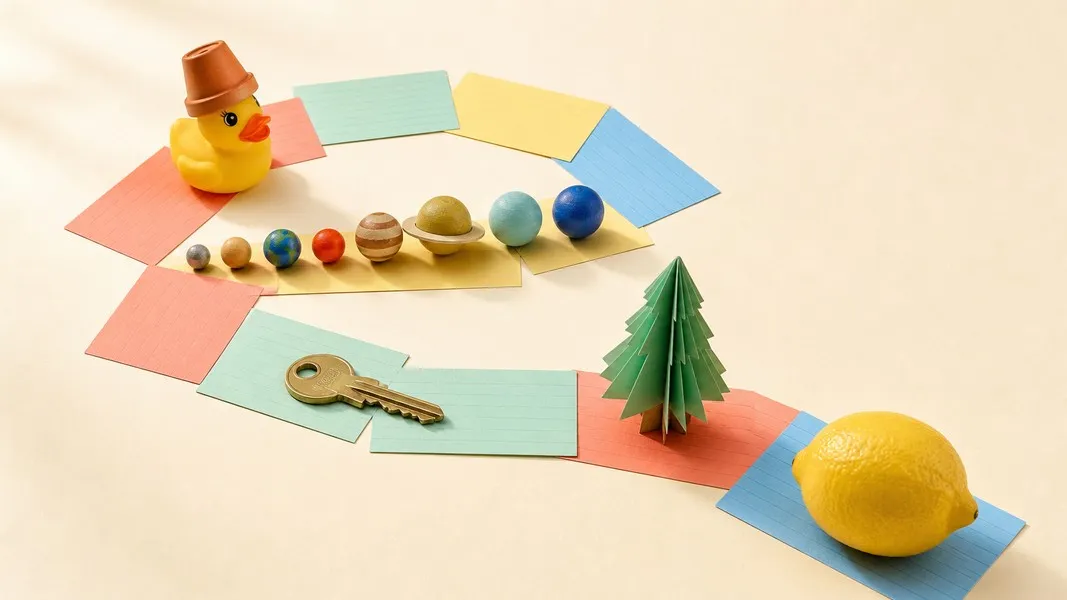
The story or link method chains items into one narrative, each linked to the next. To remember battery, umbrella, stamp and lemon, you might picture a battery opening an umbrella, which is covered in stamps, which are licked by a lemon.
It works because a story has causal order: each scene triggers the next. It is useful when you cannot rely on a fixed route or a set of pegs, and when the list is under a dozen items. The weakness is that one forgotten link can break the rest of the chain.
Mnemonic Devices for Cranial Nerves and Anatomy
Anatomy is where mnemonic devices earn their keep, because the material is long, ordered and mostly arbitrary. The twelve cranial nerves are the standard example. "Oh Oh Oh To Touch And Feel Very Good Velvet, Such Heaven" gives them in order: olfactory, optic, oculomotor, trochlear, trigeminal, abducens, facial, vestibulocochlear, glossopharyngeal, vagus, spinal accessory, hypoglossal.
A second acrostic tells you what each nerve carries. "Some Say Marry Money But My Brother Says Big Brains Matter More" maps each nerve to sensory (S), motor (M) or both (B). Olfactory is sensory, oculomotor is motor, trigeminal is both, and so on down the list.
Note what these mnemonics do and do not give you. They give you the names and their order. They do not tell you what the vagus nerve does in the heart or why damage to the facial nerve droops one side of the face. That understanding has to be built separately.
Mnemonic Devices for Science, Math, and Spelling
Outside anatomy, the same patterns show up across subjects. Please Excuse My Dear Aunt Sally, or PEMDAS, gives the order of operations in math: parentheses, exponents, multiplication and division, addition and subtraction. In chemistry, students chunk the periodic table into rows and invent sentences for the first elements of each group.
In biology, "King Philip Came Over For Good Soup" gives the ranks of classification: kingdom, phylum, class, order, family, genus, species. In music, the treble clef acrostics above are a first lesson for most students.
For spelling, one-off mnemonics work better than broad rules. "A piece of pie" separates piece from peace. "Dessert has two S's because you want seconds" separates it from desert. The narrower the mnemonic, the less likely it is to mislead you, which is the lesson the "I before E" rule teaches by failing.
What the Research Says About Mnemonic Effectiveness
A widely cited review of study techniques is a 2013 monograph by John Dunlosky and colleagues, which rated ten common methods for how useful they are to students. The keyword mnemonic received a low utility rating, alongside highlighting, rereading and summarization.
The reasons were specific. The authors found the keyword mnemonic difficult to implement in some contexts, and saw it benefit students for a limited range of materials and for short retention intervals. Practice testing and distributed practice, by contrast, were rated high utility.
That does not contradict the 88% result from 1975. It narrows it. Mnemonics produce big gains on the kind of task they were tested on: pairs of words, lists, immediate or short-delay recall. Real courses ask for more than that, and the gains shrink when the test comes weeks later or asks you to apply the idea.
When Mnemonic Devices Fail
Mnemonics fail in three predictable ways. The first is using them for understanding. An acrostic can list the steps of the Krebs cycle, but it cannot explain why the cycle exists. If an exam asks you to reason, a memorized sentence is a starting point at best.
The second is overload. Each mnemonic is a new thing to remember. Ten acronyms for one chapter can cost more effort than the material they encode, and similar acronyms start to interfere with each other.
The third is building the device and never recalling it. A mnemonic created once and then left alone fades like any other memory. For the understanding half, explaining the material out loud works better than any memory trick; Primo Notes has a Feynman mode that runs exactly that kind of spoken session and works the gaps it finds.
How to Make Your Own Mnemonic Device
Borrowed mnemonics are fine, but the ones you build yourself stick better, because building one is itself a round of processing. A simple process:
- Pick material that is a list, a sequence or an arbitrary label, not a concept.
- Choose the type that fits: acrostic for order, keyword for vocabulary, loci for long lists.
- Make it vivid, personal or absurd. Bland sentences fade first.
- Test it the next day from memory, without looking at the list.
- Drop the mnemonic once the real knowledge takes over.
Step five matters more than it looks. The goal is to stop needing the sentence: a mnemonic is scaffolding for the first weeks, not a permanent part of what you know. If your notes are already in Primo Notes, you can ask Ask AI, which chats over a single note, to draft a few acrostic options for a list in that note and keep the one that sticks.
Pair Mnemonics With Retrieval Practice
The best use of a mnemonic is as the encoding step for something you then practice recalling. A 2019 study by Miyatsu and McDaniel tested adding the keyword mnemonic to retrieval practice for foreign vocabulary and described the pairing as a potent combination. The mnemonic gets the fact in; testing yourself keeps it there.
In practice, that means turning the list into flashcards or a quiz and recalling the items at spaced intervals, using the mnemonic only when you get stuck. Our guide to active recall techniques covers how to set that up. In Primo Notes, the flashcards and quiz tools on a finished note build that practice set from your own lecture recording or photographed pages.
Conclusion
Mnemonic devices link new information to something you already know, through letters, rhymes, images, places or stories. They are the right tool for ordered lists, arbitrary names and vocabulary, and the evidence for them is strongest on exactly that kind of material.
Their limits are just as clear. Reviews rate the keyword mnemonic as low utility for general study, the evidence for the method of loci is strong in effect but weak in quality, and no mnemonic produces understanding on its own. Use them to get facts in, use retrieval practice to keep them, and let them go once the knowledge stands without them.