

Critical thinking skills are the mental abilities you use to decide what to believe and what to do: interpreting information, analyzing arguments, evaluating evidence, drawing sound inferences, explaining your reasoning, and checking your own thinking for mistakes. They are what let you read a study, a news story or a lecture slide and decide, with reasons, how much of it holds up.
You have probably been told to "think critically" in every class since middle school, usually without anyone saying what that looks like in practice. This guide does. It covers the six skills that experts agree on, concrete examples from study, work and everyday life, why these skills are harder to build than most advice admits, and nine habits that research says actually improve them.
What Are Critical Thinking Skills?
The definition most researchers start from comes from an expert consensus statement known as the Delphi Report, written up by philosopher Peter Facione. It describes critical thinking as "purposeful, self-regulatory judgment which results in interpretation, analysis, evaluation, and inference, as well as explanation" of the considerations a judgment rests on.
Two words in that definition do most of the work. Purposeful means critical thinking is aimed at a decision: what to believe, what to write, what to do next. It is not doubt for its own sake. Self-regulatory means you apply the same scrutiny to your own reasoning that you apply to everyone else's.
The Delphi Report also separates two dimensions. The first is the skill dimension, the six cognitive skills covered below. The second is the dispositional dimension: habits of mind such as curiosity, open-mindedness and a willingness to reconsider. The experts reached an 83% consensus that good critical thinkers can be characterized by these dispositions, which matters because a person can have the skills and still not use them.
Critical Thinking vs Being Critical
Critical thinking is often confused with criticizing. Pointing out flaws is one small part of it. A critical thinker is just as ready to say "this argument is strong, and here is why" as "this claim does not follow." The goal is an accurate judgment, and sometimes the accurate judgment is that the other person is right.
The 6 Core Skills for Critical Thinking
The Delphi panel identified six cognitive skills. They overlap in practice, but naming them separately helps you notice which one you are using and which one you tend to skip.
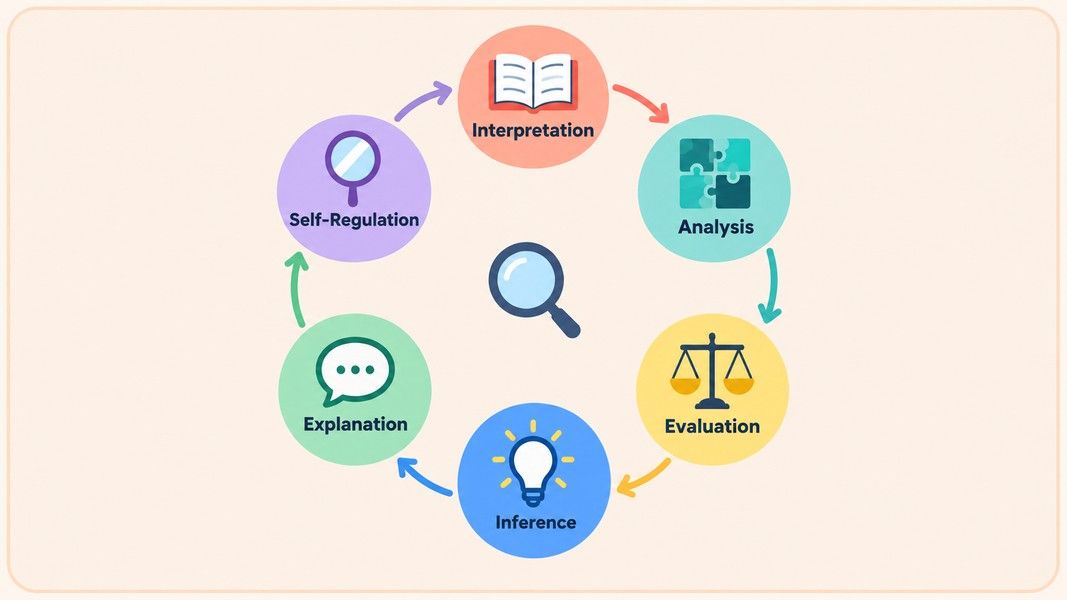
1. Interpretation
Interpretation is understanding what something means before you judge it. The report defines it as comprehending and expressing "the meaning or significance of a wide variety of experiences, situations, data, events, judgments, conventions, beliefs, rules, procedures or criteria."
In practice, interpretation sounds like: what is this author actually claiming? What does this chart show, and what does it leave out? Is this term being used the way I think it is? Many arguments go wrong at this first step, because people respond to what they assume a text says rather than to what it says.
2. Analysis
Analysis is breaking an argument or problem into its parts and seeing how they connect. You identify the main claim, the reasons offered for it, the evidence behind those reasons, and the assumptions that hold the structure together without being stated.
A useful test: can you lay out someone's argument in three or four plain sentences, premise by premise, in a way they would agree with? If you cannot, you are not ready to evaluate it yet.
3. Evaluation
Evaluation is judging how good the reasons and evidence are. Is the source credible? Is the sample large and representative? Does the evidence support the claim, or only something weaker? Are there obvious alternative explanations?
Evaluation is the skill most people mean when they say "critical thinking," and it depends heavily on knowing the subject. Judging whether a statistics claim holds up requires knowing some statistics.
4. Inference
Inference is drawing reasonable conclusions from what you have. It includes spotting what follows from the evidence, what does not, and what further information you would need before concluding anything.
A strong inference is proportional. Two bad math tests do not show that someone "is bad at math"; one striking anecdote does not establish a trend. Good inference keeps the size of the conclusion matched to the size of the evidence.
5. Explanation
Explanation is stating your reasoning clearly enough that someone else can follow and check it. The Delphi Report gives examples such as stating your reasons for holding a view and writing down your current thinking for future use.
This skill turns private judgment into something testable. If you cannot explain why you believe something, you may not have a reason at all, only a feeling of familiarity.
6. Self-Regulation
Self-regulation is monitoring and correcting your own thinking. It means asking whether your conclusion is shaped by what you wanted to be true, whether you gave the other side a fair hearing, and whether you would accept this quality of evidence if it pointed the other way.
This is the skill that ties critical thinking to thinking about your own learning, and it is the one most often missing in people who are otherwise sharp.
Critical Thinking Skills Examples
Definitions only go so far. Here is what critical thinking skills look like in situations you will actually meet.
In a Lecture or Textbook
Your biology professor says a supplement "boosts memory by 20%." Interpretation asks: 20% on what measure, compared to what? Analysis separates the claim from its support: is there a study, or is this from a press release? Evaluation asks who funded the study and how many people took part. Inference stops you from concluding the supplement works for everyone just because it worked in one small trial.
None of this requires cynicism. It requires slowing down long enough to ask what the evidence actually shows.
In an Essay or Group Project
Writing a persuasive essay is critical thinking in reverse. You build an argument, so you have to anticipate how a skeptical reader would analyze it. Strong essays name the strongest objection to their own thesis and answer it, which is self-regulation and explanation working together.
In group work, critical thinking shows up when someone asks "how do we know that?" about a claim the group was about to accept, or when the team tests two competing plans against the same criteria instead of going with whoever spoke first.
At Work
A manager sees that sales dropped after a website redesign and concludes the redesign caused it. A critical thinker checks the timeline, looks for other changes in the same period (a price change, a seasonal dip, a competitor launch), and asks what data would separate those explanations. That is analysis, evaluation and inference applied to a real decision with money attached.
Online and in the News
A viral post cites "a study" with a professional logo and a nonprofit web address. The critical thinking move is to leave the page and find out who is behind it before reading further. In a Stanford study covered in the habits below, this one move is what separated professional fact checkers from historians and students.
Analytical Skills vs Critical Thinking
Analytical skills and critical thinking are related but not identical. Analytical skills are about breaking down information: finding patterns in data, decomposing a problem, working through steps logically. They are one of the six critical thinking skills, the "analysis" step above.
Critical thinking is broader. It adds evaluation (is this good evidence?), inference (what follows?), explanation and self-regulation, and it includes dispositions like open-mindedness. You can be highly analytical and still uncritical, for example by running a flawless analysis on a dataset you never questioned.
The Delphi Report draws a similar line. It notes that not every valuable thinking skill is a critical thinking skill, and places critical thinking in a family of related higher-order abilities along with problem-solving, decision-making and creative thinking. If you want a framework for how these levels relate in school tasks, Bloom's taxonomy maps the move from remembering and understanding up to analyzing, evaluating and creating.
Why Critical Thinking Skills Are So Hard to Build
If critical thinking were a simple skill, a short course would fix it. The research suggests otherwise.
Thinking Depends on Knowing
Cognitive psychologist Daniel Willingham argues that critical thinking is not a set of generic skills you can learn once and apply anywhere. In his widely read essay for American Educator, he argues that critical thinking depends on knowing the relevant content very well and thinking about it, repeatedly, in critical ways.
His point is practical. A historian evaluates a historical source well because they know the period, the author and the conventions of the genre. Put that same historian in front of a clinical trial and their critical thinking drops sharply. What does carry over, according to Willingham, are metacognitive strategies that, once learned, make critical thinking more likely.
College Does Not Guarantee It
In their book Academically Adrift, sociologists Richard Arum and Josipa Roksa tested more than 2,300 undergraduates at 24 institutions and reported no statistically significant gains in critical thinking, complex reasoning and writing for at least 45% of them during the first two years of college.
That figure became received wisdom, and it deserves a caveat. A 2016 reanalysis in Educational Measurement: Issues and Practice argued that the statistical tests behind the 45% were conducted incorrectly, and that testing significance student by student says more about how hard individual change is to detect than about how much students learn. The careful reading is this: college exposure alone is no guarantee of better thinking, and measuring the gains is genuinely difficult.
It Has to Be Taught on Purpose
A 2008 meta-analysis by Philip Abrami and colleagues pooled 117 studies with 20,698 participants and found an average effect size of 0.341 for critical thinking instruction. Its conclusion was blunt: improvement in critical thinking "cannot be a matter of implicit expectation." Students improved most when critical thinking was an explicit goal, not a hoped-for side effect.
Common Barriers to Critical Thinking
Knowing the six skills does not mean you will use them. A few predictable forces push against clear thinking, and naming them makes them easier to catch.
Wanting a Particular Answer
When you already hold a view, you tend to examine opposing evidence harshly and supporting evidence gently. This is why self-regulation sits on the Delphi list: the most common failure is not a lack of skill but applying it unevenly. A simple check is to ask whether you would accept the same quality of evidence if it pointed the other way.
Trusting Surface Signals
A polished website, a long reference list, a confident speaker or a nonprofit address all feel like signs of credibility. In the Stanford study described below, these were exactly the features that misled historians and top students. Surface signals are cheap to fake; the reputation of a source among other sources is not.
Thinking Outside Your Knowledge
As Willingham's work shows, judgment collapses quickly once you leave a subject you understand. The danger is that it does not feel like collapse. A confident opinion about a field you know little about feels the same from the inside as an informed one. When a topic is new, the critical move is often to say "I do not know enough to judge this yet."
Time Pressure and Overload
Critical thinking is slow. Under a deadline, with too many tabs open and a lecture to catch up on, the easy path is to accept the first plausible answer. Building in a short pause before you commit to a conclusion, even a minute to ask what would change your mind, protects you from most of the mistakes that speed invites.
Handing the Thinking Over
The newest barrier is cognitive offloading: letting a tool or another person do the judging for you. Offloading memory to a calendar is harmless. Offloading evaluation, the decision about whether something is true or good, is where skills start to weaken, as the research on AI tools later in this guide suggests.
Why Employers Rank Critical Thinking So High
Critical thinking is not only an academic concern. In the World Economic Forum's Future of Jobs Report 2025, analytical thinking remains the most sought-after core skill among employers, with seven out of ten companies considering it essential. It ranks ahead of resilience, flexibility and agility, and ahead of leadership and social influence.
The same report finds that 63% of employers see skill gaps as a major barrier to transforming their business between 2025 and 2030. For students, this is a useful reframe. The habits that help you evaluate a source for an essay are the same ones that help you question a business assumption, read a contract, or judge whether a new tool is worth adopting.
How to Improve Critical Thinking Skills: 9 Habits That Work
The strongest evidence on teaching critical thinking comes from a 2015 follow-up by Abrami's team. Pooling 341 effect sizes from experimental studies, the meta-analysis found a mean effect of 0.30 and concluded that critical thinking can be taught at all educational levels and in every discipline. Three approaches stood out: opportunities for dialogue, exposure to authentic or real-world problems, and mentoring.
The nine habits below build on those findings and on the research above. If you only adopt one, make it the second: explain things out loud.
1. Build Knowledge in the Subject First
Because critical thinking depends on what you know, the fastest way to think better about a subject is to learn more of it. Before you try to critique a paper on climate models, make sure you understand the basic terms and methods. Critiquing from ignorance usually produces confident but shallow objections.
This is also why active study methods like retrieval practice matter for critical thinking: they build the solid base knowledge that judgment draws on.
2. Explain It Out Loud
Explanation is one of the six core skills, and it is also one of the best ways to find holes in your own understanding. When you try to explain a concept in plain words, gaps that felt fine in your head become obvious. Research on the self-explanation effect has long found that students who explain examples to themselves learn better and judge their own understanding more accurately.
You can do this with a study partner, a whiteboard or an empty room. Primo Notes has a Feynman mode built for it: you explain the material from your notes out loud, and the app works through the gaps in your explanation with you.
3. Ask the Question Behind the Claim
For any claim that matters, ask four things: Who is saying this? What is the evidence? What would have to be true for this to be right? What would change my mind? These questions map directly onto interpretation, evaluation and inference.
Writing the answers down, even in a line each, turns a vague feeling of agreement or doubt into reasoning you can check.
4. Read Laterally, Not Just Closely
A Stanford History Education Group study compared professional fact checkers, PhD historians and Stanford undergraduates as they evaluated live websites. According to the Stanford report, the fact checkers were the fastest and most accurate, while historians and students were easily taken in by unreliable sources.
The difference was method. Fact checkers read laterally: they glanced at a site, then opened new tabs to see what other sources said about it. Historians and students read vertically, staying on the original page and judging it by its logo, references and web address. When a source is unfamiliar, leave it and find out who is behind it before you read closely.
5. Argue the Other Side
Pick a position you hold and write the strongest case against it, strong enough that someone who disagrees with you would recognize it. This exercise trains analysis (you have to understand the structure of the opposing argument) and self-regulation (you have to notice where your own view is weaker than you assumed).
If your counterargument is weak, that usually means you do not yet understand why reasonable people disagree with you.
6. Discuss Instead of Only Reading
Dialogue was one of the three approaches with clear positive effects in the 2015 meta-analysis. Discussion forces you to explain your reasoning, hear objections you would not have thought of, and revise in real time.
A seminar, a study group or a single friend willing to push back all count. The key is that the other person is allowed to disagree and you have to respond with reasons rather than repetition.
7. Work on Real Problems
Authentic or situated problems also had positive effects in the meta-analysis. Critical thinking practiced on artificial puzzles transfers poorly; practiced on real questions in your field, it sticks.
For students, that can mean evaluating a real study cited in a news article about your subject, auditing the sources in a Wikipedia page you rely on, or checking whether a policy argument in class holds up against the data.
8. Write Down Your Reasoning
The Delphi Report lists writing down your current thinking for future use as an example of explanation. Keep a short running record of your conclusions and why you reached them: in a notebook, in the margins, or in your study notes.
When you come back to a topic weeks later, you can see whether your earlier reasoning still holds, which is self-regulation with a paper trail.
9. Find a Mentor or a Model
Mentoring was the third approach the meta-analysis found effective, and the Delphi Report recommends that instructors model critical thinking in the act of teaching. Watch how a skilled person in your field handles a weak argument or a surprising result: what they ask first, what they check, what makes them change their mind.
Then copy the questions, not the conclusions.
How to Develop Critical Thinking Skills in Each Subject
Because critical thinking is tied to knowledge, it looks different in every field. Willingham's advice to teachers is to identify the specific critical thinking moves a discipline uses, teach them explicitly, and practice them on real content. You can apply the same plan to your own studying.
History and Social Studies
Historians evaluate a document through sourcing, corroboration and context. Sourcing means interpreting a text in light of its author and intended audience: a general's memoir and a private soldier's letter describe the same battle for different reasons. Corroboration means checking one account against others. Context means placing the source in the conditions of its time rather than judging it by today's.
When you read a primary source, ask those three questions before you summarize what it says.
Science
Scientific critical thinking centers on evidence and design. When you read about a result, ask whether there was a control group, how large the sample was, whether the effect could have another cause, and whether anyone has repeated it. Willingham notes that many studies of thinking programs could not say whether gains came from the program itself, from other schooling or from life outside class, because they lacked a control group. That is exactly the question to ask of any study you cite.
Mathematics
In math, critical thinking is less about sources and more about structure. Willingham describes research showing that students solve problems more flexibly when they are taught to label each sub-step of a solution with the goal it serves. Instead of memorizing a sequence of moves, you understand why each move is there, which lets you recognize the same structure in a problem that looks different on the surface.
When you check a worked example, write a few words next to each step saying what it accomplishes.
Literature and Writing
Interpreting a novel or a poem is critical thinking with ambiguity built in. A strong reading makes a claim about the text, supports it with specific evidence from the text, and takes alternative readings seriously. The same structure applies to any argumentative essay: claim, evidence, reasoning, and a fair answer to the best objection.
Professional and Technical Fields
In nursing, law, engineering or business, critical thinking usually means matching a general rule to a specific case and noticing when the case does not fit. Case studies, clinical scenarios and past exam questions are valuable precisely because they force you to apply knowledge to situations rather than recite it.
Critical Thinking Skills and AI Tools
AI tools add a new wrinkle. A 2025 study by Michael Gerlich surveyed and interviewed 666 participants in the United Kingdom and found a significant negative correlation between frequent AI tool use and critical thinking scores, with cognitive offloading, handing mental work over to the tool, mediating the relationship. Participants aged 17 to 25 showed higher AI use and lower critical thinking scores than older groups.
A CHI 2025 study by researchers at Microsoft Research and Carnegie Mellon University surveyed 319 knowledge workers, who shared 936 examples of using generative AI at work. It found that a person's confidence in the AI and their confidence in their own ability both predicted whether they engaged in critical thinking on a task and how much effort it took.
Both studies are correlational, so they do not prove that AI erodes thinking. They do suggest a practical rule: use AI to question your understanding, not to replace it. Ask a chat tool to find the weakest step in your argument, to raise counterarguments, or to quiz you, and then check what it says against your sources. In Primo Notes, Ask AI works over a single note, so you can challenge a summary of your own lecture or reading, and the quiz tool turns that note into questions that test whether you understood it or only recognized it.
Signs Your Critical Thinking Is Improving
Critical thinking is hard to measure, even for researchers, as the debate over the 45% figure shows. You can still watch for practical signs in your own work.
You can state an argument you disagree with in a way its supporters would accept. You notice when a claim is bigger than its evidence, and you can say what evidence would be enough. You check who is behind an unfamiliar source before you read it closely. You change your mind for reasons you can name, and you can also name the reasons you did not.
In your studying, you find yourself asking "why?" and "how do we know?" about material that used to feel like plain facts to memorize. Your essays answer the strongest objection rather than the weakest. In discussions, you ask more questions and make fewer pronouncements.
None of these happen overnight. They tend to show up first in subjects you know well and spread slowly as your knowledge grows, which is exactly what the research on domain knowledge predicts.
Putting Critical Thinking Skills to Work
Critical thinking skills come down to six abilities: interpretation, analysis, evaluation, inference, explanation and self-regulation. They are not a single talent you either have or lack, and they do not develop automatically with time in school.
The research points in a consistent direction. Critical thinking grows when it is practiced on purpose, in a subject you know well, through dialogue, real problems and good models. The early evidence on AI tools suggests it suffers when you hand the judging over, whether to a confident website or to a chatbot.
Start small. Explain the next concept you study out loud, check the next unfamiliar source by leaving the page, and write one line about why you believe the next claim you accept. Those three habits exercise every one of the six skills.